Cool Carnival Map Guide - Forsaken Roblox (2026)
Master the Cool Carnival map in Forsaken. Complete guide to ride loops, tent hiding spots, generator locations, and carnival-specific strategies.
Cool Carnival is the largest open-air map in Forsaken and one of the most polarizing environments in the game with its amusement park layout featuring wide-open midway zones, towering ride structures, and scattered carnival booths that create a map unlike anything else in the Forsaken roster. The carnival theme brings massive sightlines, colorful distractions, and unique ride-based structures that function as oversized loop obstacles providing chase extensions impossible on standard maps. However, the wide-open midway areas between attractions create dangerous kill zones where killers with mobility or ranged abilities dominate survivors caught without cover. The map splits cleanly between survivor-favored ride zones (where complex structures extend chases to 60-90 seconds) and killer-favored midway zones (where open ground lets killers close distance in 10-15 seconds). Cool Carnival rewards survivors who understand which zones to occupy and which to avoid, achieving 55-60% escape rates through zone control compared to 38% for survivors who wander the midway without purpose. This guide covers every attraction, generator position, and chase strategy needed to turn the carnival from a killer's playground into your personal escape route. For context on Cool Carnival relative to other maps, visit our complete map guide at /forsaken-maps.
Quick Stats: Cool Carnival
- • Map Size: Very Large (13,000 sq studs)
- • Difficulty: Intermediate
- • Generators: 7 spawns, 5 required
- • Cover spots: 12-14 spawns
- • Major Ride Structures: 5
- • Carnival Booths: 8-10
- • Best For: Zone control and ride structure looping
- • Killer Win Rate: 49% (slightly survivor-favored)
Cool Carnival Layout and Major Attractions
Cool Carnival is laid out as a classic amusement park with a central midway boulevard connecting major ride attractions positioned around the map perimeter. The midway is a wide-open corridor (20-25 studs across) running east-west through the center with food stalls and game booths lining both sides. Major ride structures occupy the northern and southern portions of the map creating massive loop obstacles surrounded by queue line barriers, scenic elements, and maintenance areas. Understanding the layout means knowing which attractions provide strong loops, which midway sections offer cover, and how to transit between attractions without crossing dangerous open ground.
1 - Major Ride Structures
The five main rides serve as primary chase structures and landmark navigation points:
- •Ferris Wheel (Northwest): The map's tallest structure featuring a massive circular frame surrounded by queue line barriers and support struts creating a complex multi-layer loop. Survivors circle the Ferris wheel base using support struts as line-of-sight breakers while queue barriers force killers into extended pathing. The structure provides 25-35 second loops with multiple direction change points. Contains a generator spawn beneath the operator booth 50% of the time. The Ferris wheel is visible from every point on the map serving as the primary navigation landmark.
- •Roller Coaster (Northeast): A sprawling track structure with elevated sections, support pillars, and a loading station creating the map's largest single loop. The coaster track runs 60+ studs in a circuit that survivors can follow beneath, using track pillars and support beams as obstacles. The loading station contains the strongest cover spot on the map (guaranteed spawn) with a long wall creating a god-tier cover spot loop. A generator spawns at the coaster entrance 60% of the time.
- •Bumper Cars (South-Central): An enclosed arena with a low wall perimeter and scattered bumper car vehicles inside. The arena wall creates a strong 360-degree loop with bumper cars providing interior obstacles for mindgames. Survivors vault over the arena wall (low vault, fast animation) to enter or exit during chases. Contains a guaranteed cover spot inside the arena and a generator spawn 40% of the time near the control booth.
- •Haunted House Ride (Southwest): A dark enclosed ride structure with a tunnel entrance and exit, interior scenic elements, and animatronic figures creating line-of-sight breaks inside the structure. The ride tunnel provides a unique through-route that is darker than the exterior creating stealth escape opportunities. Contains a cover spot at the tunnel entrance and a generator spawn inside the ride 50% of the time. The interior darkness reduces visibility to 40% making it a strong stealth position.
- •Merry-Go-Round (Southeast): A circular ride platform surrounded by decorative fencing with horse figures and a central pole creating a medium-strength loop. The platform edge and fencing force killers into wider pathing while survivors cut through the center using the pole as a pivot point. Contains a generator spawn 30% of the time at the operator station. The merry-go-round loop provides 15-20 seconds of chase time with limited direction change potential.
- •Ride Maintenance Areas: Each major ride has a small maintenance zone behind it containing tool storage, electrical panels, and fencing. These maintenance areas provide hidden generator spawns and stealth positions that killers rarely check during standard patrols. Check maintenance areas during early game for generators that can be completed with minimal interruption.
2 - Midway Zone and Carnival Booths
The central midway and surrounding booth areas create a mixed environment of danger and opportunity:
- •Main Midway Boulevard: A 20-25 stud wide east-west corridor lined with game booths, food stalls, and decorative elements. The midway is the most dangerous transit zone on the map due to its width and clear sightlines allowing killers to spot survivors from 40+ studs. Never linger on the midway during killer patrol. Cross it quickly when transitioning between northern and southern ride structures.
- •Game Booths (8-10 scattered): Small structures measuring 6x8 studs each containing counter tops, shelves, and prize displays. Game booths provide moderate cover during midway crossings and weak-to-medium loop structures when connected to adjacent booths. Two adjacent booths create a figure-eight loop lasting 12-15 seconds. Game booths have a 20% chance of containing a generator.
- •Food Court Area (Center-West): A cluster of food stalls with tables, chairs, and trash bins creating a cluttered zone in the western midway. The food court provides the best midway-zone cover with multiple line-of-sight breaks between stalls. Tables create small obstacles for minor chase extensions. Contains a cover spot between two food stalls and a generator spawn 40% of the time at the hot dog stand.
- •Ticket Booth (Map Entrance - East): A large covered booth at the eastern map entrance serving as a secondary landmark. The ticket booth has a window counter creating a small loop and a cover spot at the entrance. Exit gates spawn near the eastern ticket booth area and the western food court area.
- •Prize Storage Shed (Center-North): A medium opaque structure containing prize inventory and storage shelves. The shed provides strong cover and interior hiding with a cover spot and dual entrances preventing dead-end scenarios. The shed is a valuable safe zone during midway transit due to its opaque walls hiding survivor movement from distant killer observation.
3 - Perimeter and Connection Zones
The map edges and connection paths between attractions provide transit options:
- •Northern Perimeter Path: A 6-8 stud wide path running behind the Ferris wheel and roller coaster connecting northwest to northeast. The path is bordered by park fencing on the outer edge and ride maintenance areas on the inner edge. This perimeter path provides safer transit between northern rides than the midway, though it is longer by 15-20 studs.
- •Southern Perimeter Path: Connects the haunted house ride to the merry-go-round along the southern map boundary. Similar construction to the northern path with fencing and maintenance area cover. This path avoids the midway entirely at the cost of routing through the map's southern edge.
- •Queue Line Barriers: Each major ride has decorative queue line barriers (rope stanchions, metal rails) extending into the midway zone. These barriers create narrow channels that slow killer movement and provide minor cover during midway crossings. Route through queue barriers when crossing the midway for 15-20% additional cover compared to open midway crossing.
- •Parking Lot (West Edge): A small paved area with scattered vehicles providing car loops similar to other maps. The parking lot contains 2-3 vehicles creating medium-strength loops and a generator spawn 30% of the time. The parking lot connects to the food court and the western escape window.
- •Service Road (East Edge): A narrow road along the eastern boundary connecting the ticket booth to the roller coaster area. Contains a utility truck providing a single vehicle loop and connects to the eastern escape window.
Generator Strategy for Cool Carnival
Generator strategy on Cool Carnival is dominated by the fundamental split between ride zone generators (safer, with strong loops nearby) and midway zone generators (dangerous, with minimal cover). The map's large size means killer patrol routes take 35-45 seconds to complete full circuits, providing generous repair windows compared to smaller maps. However, the clear midway sightlines allow killers to spot generator progress from 30+ studs when generators are positioned in open areas. Successful Cool Carnival generator strategy leverages the ride structure safety zones while eliminating dangerous midway generators early.
Generator Priority and Sequencing
Complete generators in this order for maximum safety and 3-gen prevention:
- •Priority 1 - Food Court Midway Generator: When it spawns at the hot dog stand, this exposed midway generator is the most dangerous late-game target. The food court provides some cover through stall clutter but the generator is visible from both ride zones across the midway. Complete within the first 120 seconds using cooperative repair to minimize exposure time.
- •Priority 2 - Ticket Booth or Open Midway Generators: Any generator spawning in the midway corridor without adjacent ride structure cover should be completed second. These generators become impossible to repair during late game when killer patrol concentrates around remaining generators in the most visible map area.
- •Priority 3 - Bumper Car Generator: The bumper car arena generator has moderate exposure due to the arena's open interior visible from the midway. Complete this as your third generator while the arena cover spot and wall loop remain intact for chase escape.
- •Priority 4 - Merry-Go-Round Generator: When it spawns, the merry-go-round generator has moderate visibility. Complete mid-game using the ride loop as escape insurance. The operator station provides partial cover during repair.
- •Priority 5 - Ride Structure Generators Last: Save the Ferris wheel, roller coaster, and haunted house generators for your final completions. These generators are protected by the strongest loop structures on the map making them the safest endgame repair positions. Having the roller coaster strong cover spot available during your final generator completion provides maximum chase safety.
- •Three-Gen Prevention: Cool Carnival's most common 3-gen clusters around the bumper car arena, merry-go-round, and a midway booth creating a southern triangle with 25-30 stud sides. Complete at least two of the three southern generators before your fourth total to prevent this configuration.
- •Large Map Advantage: Cool Carnival's 13,000 sq stud size means killers cannot efficiently patrol all generators. Use the map's size to your advantage by repairing generators on the opposite side from the killer's current position. You have 35-45 seconds of safe repair time when the killer commits to a distant ride structure.
Repair Positioning at Ride Structures
Use ride structures to maximize repair safety:
- •Ride Side Positioning: When repairing generators near ride structures, position yourself on the side of the generator facing the ride structure rather than facing the midway. This places the ride between you and the killer's most likely approach direction providing visual cover and immediate access to the ride loop if interrupted.
- •Maintenance Area Stealth: Generators spawning in ride maintenance areas behind attractions benefit from being off the killer's standard patrol route. These generators can often be completed without interruption during entire matches because killers focus patrols on visible generators near the midway.
- •Queue Line Warning System: Queue line barriers around rides create sound channels that amplify killer footsteps approaching from the midway direction. Listen for footstep audio changes in queue barriers for 4-6 second advance warning of killer approach.
- •Ride Operator Booth Cover: Several generators spawn near ride operator booths that provide waist-high counter cover. Crouch behind the operator counter while repairing for 30-40% reduced visibility from killer sightlines.
- •Escape Route Pre-Planning: Before starting any generator repair, identify which ride structure loop is closest and plan your escape route. On Cool Carnival, your escape route should always lead to a ride structure loop rather than into the open midway where killers have clear sightlines.
Chase Mechanics and Ride Structure Looping
Cool Carnival chases divide into two completely different experiences: ride structure chases that can last 60-90 seconds through complex multi-obstacle loops, and midway chases that end in 10-15 seconds when survivors are caught in open ground without nearby structures. The skill on Cool Carnival is maintaining positioning near ride structures at all times and routing chases toward these massive loops rather than allowing killers to push you into the midway kill zones. Ride structures on Cool Carnival are some of the largest loop obstacles in all of Forsaken, providing chase extensions that exceed even the Forest map's lodge structure through sheer physical size and obstacle density.
Ride Structure Loop Techniques
Maximize chase duration at each major attraction:
- •Roller Coaster God Cover spot: The loading station strong cover spot is the strongest single cover spot in Forsaken. The long wall attached to the loading station creates a loop requiring 20+ seconds to counter through respecting or 2 seconds through breaking (providing 10 studs of distance during break animation). Killers who respect the cover spot lose 25-30 seconds per loop rotation. After the cover spot drops, transition to the track pillar loops for additional 20-30 seconds.
- •Ferris Wheel Base Loop: Circle the Ferris wheel base using the four main support struts as line-of-sight breakers. Each strut blocks killer vision for 1.5-2 seconds per rotation allowing direction changes. The queue barriers extending from the wheel create additional pathing obstacles. Combine support struts and barriers for 25-35 second loops before transitioning to northern perimeter path.
- •Bumper Car Arena Loop: Vault over the arena wall to enter, circle the interior using bumper cars as obstacles, then vault out when the killer enters. The wall vault forces killers to decide between vaulting (slower animation) or running to the entrance. This vault-circle-vault pattern creates 15-20 second loops per cycle and can be repeated 2-3 times before the killer adapts.
- •Haunted House Through-Route: Enter the haunted house ride through the tunnel entrance, use animatronic figures and scenic elements as interior obstacles, then exit through the ride exit on the opposite side. The dark interior (40% visibility) creates stealth escape opportunities mid-chase where you break line of sight among the ride scenery.
- •Merry-Go-Round Pivot: Use the central pole as a tight pivot point circling at 6-8 stud radius while the platform edge and fencing force killer into wider 12-14 stud radius creating speed differential advantage. The merry-go-round provides 15-20 seconds of loop time but lacks direction change opportunities making it predictable after 2-3 rotations.
- •Booth Chain Looping: When near the midway, chain between adjacent game booths creating figure-eight loops using booth counters and displays as obstacles. Each booth provides 5-8 seconds of chase time but chaining 3-4 booths creates 20-30 second sequences that buy enough time to reach a major ride structure.
- •Vehicle Loops: Parking lot and service road vehicles provide standard car loops lasting 15-20 seconds per vehicle. Chain between 2-3 vehicles for extended sequences when ride structures are too distant to reach safely.
- •Structure Transition Routing: Plan chase routes that connect ride structures: Ferris wheel to roller coaster (northern perimeter), bumper cars to merry-go-round (southern perimeter), haunted house to food court (western zone). These transitions avoid the dangerous midway while maintaining access to strong loop structures.
Midway Survival and Zone Control
Manage the dangerous midway zone through positioning and awareness:
- •Midway Avoidance Rule: Never position yourself in the center of the midway boulevard during killer patrol. The 20-25 stud width provides zero cover and clear sightlines from 40+ studs. Always hug the booth-lined edges of the midway where game booth covers provide partial concealment and emergency loop opportunities.
- •Booth Cover Hopping: When crossing the midway is necessary, move between booth covers in short bursts. Sprint from one booth to the next (8-12 studs) then pause behind the booth to check killer position before sprinting to the next. This hop pattern reduces exposure from a single 25-stud open sprint to multiple 8-12 stud covered sprints.
- •Queue Barrier Routing: Use queue line barriers extending from ride structures as covered corridors through the midway. Barriers are 4-5 studs tall providing full standing cover while funneling you toward ride structures. Route through barriers whenever they align with your destination.
- •Pre-Running from Midway: If caught on the midway, immediately sprint toward the nearest ride structure. Do not attempt to loop midway obstacles (vendor carts, balloon displays) as these provide 2-3 seconds maximum and waste the time needed to reach a real structure. Commit fully to reaching the nearest ride.
- •Fog and Lighting Exploitation: Cool Carnival features ambient fog effects near ground level that reduce long-range visibility by 15-20%. Crouch walking through fog zones on the midway reduces your visual profile. Additionally, the carnival lights create alternating bright and shadow zones; time midway crossings to pass through shadow areas.
- •a burst-speed ability Midway Crossing: Save a burst-speed ability specifically for emergency midway crossings. The 2.5-second speed boost covers 10-12 studs of open midway in sprint time, reducing the dangerous exposure window when you must cross from south to north or vice versa.
- •Killer Commitment Reading: When the killer chases someone at a ride structure, you can safely cross the midway knowing the killer is occupied for 30-60 seconds. Use teammate chase sounds from ride structures as safe crossing signals.
Pro Tip
The Ferris wheel is visible from every position on Cool Carnival. Use it as your compass: the Ferris wheel is always northwest. When disoriented, look for the Ferris wheel silhouette to instantly orient yourself. Knowing the Ferris wheel is northwest tells you the roller coaster is northeast, the haunted house is southwest, the merry-go-round is southeast, and the midway runs east-west between them. This single landmark provides complete map orientation within 1-2 seconds, preventing the navigation delays that cost generators on this large map.
Killer-Specific Cool Carnival Strategies
Cool Carnival's split between wide-open midway and complex ride structures creates dramatic killer tier shifts. Killers with ranged or mobility abilities dominate the midway but struggle at ride structures, while M1 and stealth killers perform poorly on the midway but can compete at ride loops. Understanding these dynamics lets you adjust your positioning based on the killer you face, staying near ride structures against mobility killers or playing more aggressively on midway generators against M1 killers. For killer ability details, check our guide at /forsaken-killers.
High-Threat Cool Carnival Killers
These killers exploit the map's open zones:
- •Ranged Killers (Rust, Guest 666-equivalents): The midway boulevard provides perfect shooting lanes with 30-40 stud clear sightlines. Ranged killers achieve 65%+ hit rates on the midway compared to 45% on standard maps. Counter by never positioning on the open midway and using ride structure obstacles to block projectile lines during every chase.
- •Nosferatu and Chainsaw Killers: The midway and perimeter paths provide long chainsaw sprint lanes covering 30-40 studs at maximum speed. Chainsaw killers dominate Cool Carnival transitions when survivors move between ride structures. Counter by routing through ride maintenance areas and queue barriers rather than open paths, forcing chainsaw charges to collide with obstacles.
- •Mobility Killers: The map's large size normally disadvantages mobility killers through extended patrol times, but Cool Carnival's open layout allows dash and teleport abilities to function at full effectiveness. Mobility killers patrol the 13,000 sq stud map as efficiently as smaller maps. Counter by repairing generators at ride structures where mobility powers lose effectiveness among complex obstacles.
- •Tracking Killers: Cool Carnival's size makes tracking abilities extremely valuable for locating survivors across the large map. Killers with aura reading or enhanced scratch mark detection eliminate the large-map hiding advantage that normally helps survivors. Run Distortion against tracking killers on Cool Carnival.
Lower-Threat Cool Carnival Killers
These killers struggle with the map's unique properties:
- •Stealth Killers: Cool Carnival's open sightlines and large distances make stealth approaches visible from 25-30 studs even for stealth killers. The midway provides clear views of killer movement that stealth cannot fully conceal on open terrain. Play aggressively on generators against stealth killers knowing their approach is visible from greater distances than on indoor or cluttered maps.
- •Trap Killers: The map's massive size and numerous paths between structures make trap coverage impossible. Trap killers can cover 2-3 chokepoints while 10+ alternative paths remain open. Check common trap locations at ride structure entrances but play confidently knowing the killer cannot trap enough paths to restrict your movement on this oversized map.
- •M1 Killers Without Mobility: Basic M1 killers without movement abilities struggle with Cool Carnival's size. Patrol routes take 35-45 seconds allowing generous repair windows, and ride structure loops provide 30-60 seconds of chase time that M1 killers without power shortcuts cannot overcome. Against M1 killers, repair confidently knowing you have 35+ seconds before the killer arrives from across the map.
- •Anti-Loop Killers: While anti-loop abilities counter standard cover spots and windows, ride structure loops on Cool Carnival use oversized physical obstacles (Ferris wheel struts, coaster pillars, bumper car walls) that anti-loop abilities cannot bypass. The sheer physical size of ride loops negates anti-loop powers more effectively than standard tiles on other maps.
- •General Strategy: Against weaker Cool Carnival killers, increase time spent on midway generators during early game. The killer's reduced effectiveness means midway generator completion becomes less risky, allowing you to eliminate dangerous generators while the killer struggles to apply pressure across the oversized map.
Advanced Cool Carnival Techniques
Cool Carnival's unique amusement park environment enables advanced techniques that do not exist on any other Forsaken map. The ride structures, queue line systems, and carnival atmosphere create tactical opportunities for survivors who invest time learning the map's specific mechanics.
Ride Mechanic Exploitation
Advanced techniques using ride-specific features:
- •Haunted House Stealth Break: Enter the haunted house ride during chase, use the dark interior (40% visibility) to crouch behind animatronic figures breaking line of sight, then exit through the opposite side while the killer searches the dark interior. This stealth break succeeds 40-50% of the time and completely resets the chase.
- •Bumper Car Wall Vault Chain: Practice vaulting over the bumper car arena wall at multiple points around the perimeter. Fast vaulting over the low wall at one point, running along the exterior, then fast vaulting back in at a different point creates unpredictable chase patterns that killers cannot anticipate.
- •Roller Coaster Pillar Weaving: The coaster track pillars along the ride circuit provide alternating line-of-sight breaks every 8-10 studs. Weaving between pillars while maintaining distance creates a chase path where the killer loses visual contact for 1-2 seconds per pillar, allowing incremental direction changes that accumulate to complete loss of tracking.
- •Ferris Wheel Queue Barrier Maze: The Ferris wheel queue line barriers extend 20-30 studs from the ride into the midway creating a maze-like corridor system. Leading chases through the queue barrier maze forces killers into predictable paths while survivors cut through barrier gaps for shortcuts. This technique wastes 15-25 seconds per chase through barrier navigation.
- •Merry-Go-Round Platform Drop: Jumping onto the merry-go-round platform and using the horse figures as cover creates a unique elevated chase where the platform edge height provides a micro-advantage in hit detection timing. This technique is mechanically demanding but provides 3-5 extra seconds per loop rotation through height advantage.
Team Strategy and Endgame
Coordinated team play on Cool Carnival's large map:
- •Map Sector Assignment: Divide Cool Carnival into four sectors (NW-Ferris, NE-Coaster, SW-Haunted, SE-Merry) with one survivor assigned primary repair responsibility in each sector. This distribution ensures all generators receive attention while preventing multiple survivors from clustering in one area.
- •Chase Bait Positioning: Intentionally position one survivor at a ride structure visible from the midway to bait the killer into a chase. While the killer commits to the 30-60 second ride loop chase, three teammates repair generators across the map with guaranteed safety. Rotate the bait role between survivors with strongest chase mechanics.
- •Midway Generator Rush: Coordinate two survivors with Prove Thyself on midway generators while two others monitor killer position from ride structures. The moment both lookouts confirm killer position at a distant ride, the repair pair has 35-45 seconds to complete the generator through cooperative repair (40 seconds with Prove Thyself). This coordinated rush eliminates dangerous midway generators efficiently.
- •Endgame Gate Strategy: Cool Carnival escape window spawn at east (ticket booth) and west (parking lot) positions separated by the entire midway. Position two survivors at each gate. The map's massive size means the killer cannot effectively patrol between gates in less than 20-25 seconds, guaranteeing at least one gate opens during their transit.
- •Rescue Routing: When teammates get downed at ride structures, approach for rescue through the ride's maintenance area rather than across the visible midway. Maintenance area approaches avoid killer detection during patrol and provide immediate ride loop access for post-rescue chase protection.
- •SWF Carnival Build: For coordinated teams, bring one a burst-speed ability (midway crossing), one Prove Thyself (generator speed), one rescue protection (rescue support), and one We'll Make It (post-rescue healing). This composition addresses Cool Carnival's specific challenges of midway exposure, large-map generator pressure, and ride structure rescue scenarios. Visit /forsaken-survivors for complete build recommendations.
Cool Carnival Attraction Comparison
| Attraction | Loop Time | Cover spots | Generator | Visibility | Chase Rating |
|---|---|---|---|---|---|
| Roller Coaster | 40-60s | 1 God + 1 | 60% | Medium | 10/10 |
| Ferris Wheel | 25-35s | 0-1 | 50% | Medium | 8/10 |
| Bumper Cars | 15-20s per cycle | 1 | 40% | High | 7/10 |
| Haunted House | 20-30s + stealth | 1 | 50% | Low (dark) | 8/10 |
| Merry-Go-Round | 15-20s | 0 | 30% | High | 5/10 |
| Food Court | 10-15s | 1 | 40% | Medium | 4/10 |
| Game Booths | 5-8s each | 0-1 | 20% each | Medium | 3/10 |
| Parking Lot | 15-20s per car | 0 | 30% | High | 5/10 |
Cool Carnival Midway Death Zone
The central midway boulevard is responsible for 45% of all survivor downs on Cool Carnival. The 20-25 stud wide open corridor provides zero cover and allows killers to spot, chase, and down survivors within 10-15 seconds when caught without nearby structures. Never repair generators, heal teammates, or idle on the open midway. Always position at ride structures or booth cover when not actively transitioning between areas. If you must cross the midway, sprint directly perpendicular to the boulevard reaching the nearest ride structure in minimum time rather than traveling along the midway length where exposure extends to 30+ studs of open ground.
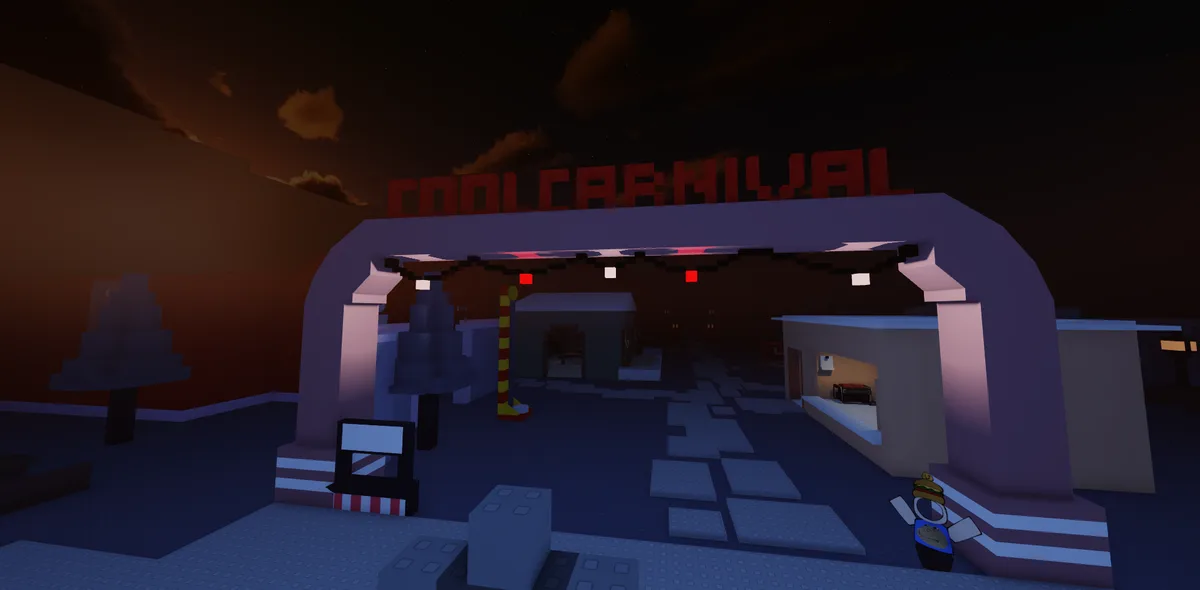
The c00l Carnival map in Forsaken. Image: Forsaken (Roblox) © Forsaken Dev Group, via the Official Forsaken Wiki (forsaken.wiki).
Final Thoughts
Cool Carnival is a map of extremes: the safest loops in Forsaken exist alongside the most dangerous open areas, and your escape rate depends entirely on which zones you occupy throughout the match. The survivors who master Cool Carnival are not the ones with the best mechanical looping skills but rather the ones with the best positional awareness, knowing when to stay at ride structures, when to risk midway crossings, and when to commit to long perimeter paths that trade time for safety. The map rewards patience and planning over aggression and improvisation. Start your Cool Carnival improvement by memorizing the five ride structure positions and practicing each structure's primary loop for 15-20 minutes in custom matches. Then learn the midway crossing techniques using booth cover hopping and queue barrier routing. Finally, implement the generator priority sequence that eliminates dangerous midway generators early while preserving ride structure generators for safe late-game completions. Your Cool Carnival escape rate will reflect your zone control discipline: survivors who stay near ride structures maintain 55-60% escape rates while those who wander the midway without purpose drop to 35-40%. The difference is not mechanical skill but strategic positioning that this guide provides the framework to develop.
- • Cool Carnival splits between survivor-favored ride structure zones and killer-favored midway open areas creating a zone control map where positioning determines outcomes
- • The roller coaster loading station contains the strongest strong cover spot in Forsaken providing 25-30 seconds of guaranteed safe looping when used correctly
- • Complete midway boulevard generators first within opening 120 seconds to eliminate the most exposed repair positions before killer pressure develops
- • The Ferris wheel serves as a universal navigation landmark visible from every map position for instant orientation in the 13,000 sq stud environment
- • Never linger on the central midway boulevard which accounts for 45% of all survivor downs through 20-25 stud open sightlines with zero cover
- • Ranged and chainsaw killers dominate the midway while struggling at ride structures making ride proximity essential against these killer types
- • Ride maintenance areas behind attractions provide stealth recovery positions that killers rarely check during standard patrol rotations
Load a custom Cool Carnival match and practice looping all five ride structures for 30 minutes. Start at the roller coaster strong cover spot, move to the Ferris wheel base loop, practice bumper car wall vault chains, run the haunted house stealth break, and time your merry-go-round pivot. Then practice midway crossing using the booth hop technique between the food court and prize storage shed. These six practice exercises cover 90% of the mechanical skills needed for Cool Carnival mastery.
Related Forsaken Guides
Horror Hotel Map Guide - Forsaken Roblox (2026)
Master the Horror Hotel map in Forsaken. Floor-by-floor guide with room loops, elevator strategies, generator locations, and killer avoidance tips.
The Tempest Map Guide - Forsaken Roblox (2026)
Survive The Tempest map in Forsaken. Complete guide covering storm mechanics, generator locations, visibility strategies, and optimal escape routes.
Planet Voss Map Guide - Forsaken Roblox (2026)
Master the Planet Voss map in Forsaken. Navigate alien terrain, find hidden generators, and use the unique environment for survival strategies.
SFOTH Map Guide - Forsaken Roblox (2026)
Complete SFOTH (Sword Fight on the Heights) map guide for Forsaken. Learn the classic Roblox layout adapted for asymmetrical horror gameplay.
Yorick's Resting Place Map Guide - Forsaken Roblox (2026)
Navigate Yorick's Resting Place in Forsaken. Complete cemetery map guide with tombstone loops, crypt hiding spots, and graveyard escape strategies.
Back to the ForsakenHub homepage for the full Forsaken Roblox guide hub, or browse all guides. You can also play the game directly on Forsaken on Roblox.