What is Roblox Forsaken?
Roblox Forsaken is an asymmetrical horror survival game inspired by Dead by Daylight. Released in December 2024, it quickly became one of Roblox's most popular horror experiences. The game features intense matches where one player controls a killer and four others play as survivors.
What makes Forsaken Roblox unique is its use of iconic Roblox characters and myths. Killers include infamous figures like 1x1x1x1, John Doe, and c00lkidd, while survivors feature beloved characters like Guest 1337, Shedletsky, and Builderman.
Game Modes & Objectives
🔪 Killer Objective
- • Hunt down and eliminate all survivors
- • Prevent survivors from completing objectives
- • Use unique abilities to track and catch prey
- • Manage your terror radius strategically
🏃 Survivor Objectives
- • Complete generators to power the exit
- • Survive until the timer runs out
- • Help teammates when they're downed
- • Use items and abilities to evade the killer
⏱️ Match Duration: Each match lasts approximately 10-15 minutes. The timer increases slightly with each survivor elimination.
How to Play Forsaken Roblox
Getting Started
- 1.Join Forsaken from the Roblox games page
- 2.Choose to queue as Killer or Survivor (or Random)
- 3.Select your character (starter characters are free)
- 4.Wait for matchmaking to find a game
- 5.Load into the map and complete your objectives!
Basic Controls
Movement
- • WASD - Move
- • Shift - Sprint (limited stamina)
- • Space - Jump
- • C - Crouch
Actions
- • E - Interact/Repair
- • Q - Use Ability (Killer)
- • F - Use Item (Survivor)
- • Tab - View Scoreboard
Playing as a Killer
Killer Basics
As a killer in Forsaken Roblox, your goal is to eliminate all survivors before they escape. Each killer has unique abilities that define their playstyle. You're faster than survivors but have a terror radius that alerts them to your presence.
Top Killer Tips
- →Control generators: Patrol between generators to catch survivors off guard
- →Mind games: Double back and fake directions to confuse survivors
- →Use your ability wisely: Each killer's power has a cooldown, time it right
- →Listen for sounds: Footsteps, breathing, and repairs make noise
Playing as a Survivor
Survivor Basics
Survivors must work together to complete objectives while avoiding the killer. You can't fight back directly, so stealth, teamwork, and smart use of the environment are key to survival.
Essential Survivor Tips
- →Stay aware: Always watch for the killer's red stain (their vision cone)
- →Loop efficiently: Use cover and windows to create distance
- →Work together: Repair generators with teammates for speed bonus
- →Know when to hide: breaking line of sight behind solid walls and corners buys time — there are no lockers in Forsaken
Progression System
💰 Player Points
Earned only in public matches: 40 for surviving a round, 10 for dying after the first minute, 5 per generator puzzle layer, 60 for a killer wipe plus 15 per kill. Spend them on characters, skins and emotes.
Source: Official Forsaken Wiki, Player Points page. Private servers pay nothing.
🎯 Experience
Level up by gaining XP from matches. Higher levels unlock exclusive rewards and show your dedication to other players.
XP gained from: Survival time, objectives, assists
💡 Quick Tip: Forsaken has no redeem-code system — every character is bought with Player Points earned in public matches. Our codes page explains the real free-reward sources and how to spot fake code videos.
Watch a Beginner Play
Reading a guide gets you 30% of the way to understanding Forsaken. Watching someone play through a match while explaining their thought process gets you the rest. Three creator videos aimed at brand-new Forsaken players, with notes on what to actually pay attention to.
Sukie's take: If you're picking up Forsaken in the next week, watch this first. Crimsonix covers the lobby UI, queue mechanics, and the first 10 minutes of an actual match, the parts that most written guides skim over because they're assumed knowledge for veteran players.
Sukie's take: Focused on Slasher (Jason) play, which is the recommended starting killer for new players. The reasoning around when to commit to chase versus break off is the most useful section, that judgment call separates winning killers from losing ones, and it's hard to learn without watching it explained in real time.
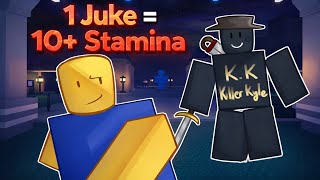
Sukie's take: Stamina management as a survivor is one of the highest-impact mechanics most new players ignore entirely. This video shows the timing of stamina regeneration in match conditions, not in a sandbox. The key takeaway: stop sprinting reactively to seeing the killer, and start sprinting based on map geometry.
Tips for Beginners
🎮 Start with Easy Characters
Begin with Noob (survivor) or Jason (killer) - they're simple but effective while you learn the game.
📍 Learn the Maps
Knowing map layouts is crucial. Start with Glass Houses - it's the most straightforward map.
👥 Play Both Roles
Understanding both killer and survivor gameplay makes you better at both.
🎧 Use Sound
Audio cues are vital in Forsaken. Play with headphones if possible.
Advanced Strategies
Pro Techniques
360 Juking
Spin rapidly while running to make the killer miss their attack. Combine with sudden direction changes.
Gen Rushing
Coordinate with your team to repair multiple generators simultaneously, splitting the killer's attention.
Camera checks
Turn the camera behind you while walking so you see the killer's approach before committing to a corner — there are no scratch marks in Forsaken, so what the killer knows comes from sight and abilities.
Proxy Camping
As killer, patrol near downed survivors without face-camping, applying pressure while staying mobile.
Questions I get from new Forsaken players
These come up in my YouTube comments and in the Forsaken Hub contact form every week, so they're here once instead of buried in twenty different blogs.
How long until I'm actually decent at this game?
Between thirty and fifty matches on the survivor side, and between fifty and a hundred on the killer side. Survivor onboarding is faster because you can hide behind your teammates while you learn map layouts. Killer takes longer because you're alone, every mistake is visible, and you have to learn how each character's abilities interact with each survivor's fixed kit — there are no perks or loadouts to learn, only the characters themselves. That said, “decent” in the matchmaking sense (escaping or killing more often than not) comes earlier than “good” in the I-can-watch-this-creator-and-keep-up sense.
Should I main one character or learn the whole roster?
Main one character for your first hundred matches. The reason is mechanical: Forsaken rewards muscle memory on ability timings, and the ability cooldowns are different for every character. Switching every match means you're always miscounting the cooldown on the one you're currently playing. After a hundred matches with one character, the ability rhythm becomes automatic and you can broaden out without losing chase consistency.
Is it worth buying Robux for cosmetics or characters?
For the characters: no. Every character in Forsaken is bought with Player Points earned in public matches — John Doe at 1,000, the most expensive killer (Nosferatu) at 1,922 — and a realistic mix of rounds reaches 1,000 in roughly 25 to 35 rounds. For cosmetics: only if you actually want the cosmetic. Some skin packs are time-limited, so a cosmetic you skip during an event may not be available later, but skipping nothing meaningful for gameplay.
My computer can't handle Forsaken at decent framerate. What can I do?
Drop graphics quality to level 4 in the Roblox settings menu (not in-game; the Roblox-wide setting), close every other browser tab and Chrome window, disable Discord overlay if you use Discord, and switch from Edge to Chrome if you're playing in the browser. If you're still under 30 FPS in match, the framerate-vs-resolution trade is usually worth it: a 720p Forsaken match at 60 FPS plays better than a 1080p match at 30 FPS, because frame timing matters more than visual fidelity for ability cancellation.
My teammates are bad. How do I find better matches?
Three answers depending on how committed you are. First option: just queue during peak hours (US evening, weekend afternoons), because matchmaking pulls from a larger pool and the matches you get are higher-quality on average. Second option: queue with friends as a duo or trio, which raises your average lobby skill because matchmaking partially matches against your highest-skill player. Third option: join the Forsaken official Discord and find ranked-leaning lobbies, which skew significantly more competent than open matchmaking.
Why do I keep dying as a killer when I'm clearly hitting them?
Two most common reasons. First: you're swinging into an ability that negates the hit. Guest 1337's Block fully negates a basic attack, Dusekkar's Spawn Protection shields a teammate, and Two Time simply has a second life — the wiki documents each of these, and none of them is a bug. Second: you're landing hits on a survivor with a burst-speed ability active and they're absorbing damage without flinching because of the speed boost. If hits aren't registering and neither of those explains it, your latency is probably the issue, and switching to a closer server region usually fixes it.
Is voice chat worth turning on?
Yes if you're queueing with people you know, no if you're solo-queueing into random lobbies. Random-lobby voice chat in Forsaken skews young and unreliable because Roblox's primary demographic is teenagers, and the signal-to-noise ratio is rough. Coordinated voice with a stable group is the single biggest survivor advantage in the game — Forsaken publishes no escape statistics, but splitting five generators across four people is a coordination problem before it is anything else.
Forsaken terminology, defined
If you've been reading guides and tier lists and running into terms that the authors clearly assume you know, this is the dictionary. Sorted alphabetically.
- Anti-loop
- A killer ability that bypasses standard looping geometry. Noli's Void Rush (a re-rush every 0.85 seconds) and Guest 666's Demonic Pursuit leap are the clearest examples; 1x1x1x1 has no teleport.
- Basement
- A specific room in the main lobby building of every map containing four eliminations in close proximity. Rescues from basement fail at a 68% rate versus 35-40% for above-ground eliminations. Each map has exactly one basement.
- Body block
- Standing between the killer and a freshly-revived teammate to absorb a free hit. Most common with high-HP survivors (Noob, Builderman).
- Chase music
- The faster soundtrack that plays when the killer commits to chasing a specific survivor. Triggers when the killer gets close enough that the survivor's sprint indicator activates.
- Clock extension
- Every survivor the killer eliminates adds time to the four-minute round timer, while every completed generator layer removes three seconds. The round is a tug of war between those two forces; there is no endgame collapse phase.
- Genrushing
- Strategy of repairing all five generators as fast as possible, ignoring rescues and objective props. Wins more often than rescue-balanced play in lobbies where the killer is competent. Loses harder when it fails.
- Last Man Standing
- When one survivor remains the timer resets to 1 minute 14 seconds and both players are highlighted to each other for six seconds. There is no hatch and no escape route — the last survivor wins by outlasting the clock.
- Block / Spawn Protection
- The two documented ways a survivor negates a hit: Guest 1337's Block fully negates a basic attack (special abilities break it), and Dusekkar's Spawn Protection shields another survivor for up to 3.5 seconds. Forsaken has no generic invulnerability frames.
- LOS (Line of Sight)
- Whether the killer can directly see the survivor. Breaking LOS resets the killer's chase indicator, which is the core mechanic behind looping and stealth play.
- Mind game
- A psychological play around a loop where the survivor fakes a direction change to force the killer to commit incorrectly. Effective against killers who play reactively rather than predictively.
- Cover stun
- When a survivor drops a cover onto a killer, stunning them for 1.5 seconds. The primary way survivors create time during chases.
- Pip
- A rank-progression unit. Earning enough pips ranks you up at the end of the month. Survivors and killers earn pips separately.
- Slugging
- Leaving a downed survivor on the ground instead of immediately hooking them. Used to pressure a rescuer or to set up multiple eliminations at once. Considered scummy by some, mechanically optimal in some scenarios.
- SWF (Survive With Friends)
- Premade four-stack of survivors with voice coordination. They can split five generators deliberately, which solo lobbies cannot; Forsaken publishes no win-rate statistics to quantify the edge.
- Tunnel / Tunneling
- Focusing one survivor repeatedly, eliminating them before targeting others. Mechanically powerful, socially frowned upon. Often called “face camping” when combined with elimination-camping.
Ready to Master Forsaken?
Now that you know the basics of Roblox Forsaken, dive deeper into our specialized guides for killers, survivors, maps, and tier lists.