Two Time in Forsaken: Second Life Guide, Trades & Endgame Plays (2026)
High-value Two Time guide for Forsaken: what to spend your second life on, how to trade correctly, and how to close endgames cleanly.
Two Time is a “second life” support survivor: your value comes from converting one extra chance into real tempo (saves, resets, and endgame escapes). Two Time is easy to misunderstand. New players treat the kit like invincibility and sprint into bad plays; strong players treat it like insurance that lets them take one high-value risk at the correct moment. This guide is built around that idea: what risks are worth taking, how to plan around your second life instead of hoping it happens, and how to coordinate so your teammates don’t accidentally waste your best window.
Quick Stats: Two Time (Community Listing)
- • Unlock Cost: 500 Player Points
- • Role: Support / clutch saver
- • Core Identity: One extra “chance” (second life mechanic)
- • Best Use Case: Rescue timing + endgame trading
- • Biggest Weakness: Wasting the second life on low-value chases
Pay attention to when the player “spends” the second life: it’s usually for a rescue or endgame trade, not for a random midgame chase.
Two Time “Value Table” (What To Spend Your Second Life On)
You don’t need perfect ability knowledge to play Two Time well—you need a clear priority list.
| High-Value Spend | Why It’s Worth It | What Your Team Does | What You Avoid |
|---|---|---|---|
| Elimination save vs camping pressure | Trading your extra life converts a near-guaranteed death into a reset. | One teammate commits the rescue with you; others stay on objectives. | Solo hero saves with no follow-up plan. |
| Endgame gate trade | Endgame is already high-risk; your extra life makes a 50/50 into a favored play. | Group near gate; decide “leave on first down.” | Chain-dying: don’t let the whole team die trying to rescue you. |
| Body block to secure distance for an injured teammate | One block can save a full elimination states and keep objectives moving. | Injured teammate rotates to safe cover; you reset after trade. | Blocking when you’re already out of position (you’ll just get downed for free). |
| Risky objective tap to finish progress | Finishing a key objective before going down is often match-winning. | Team stops hovering and commits to split progress. | Taking chase for “fun” when there’s no objective value. |
If you want one rule: spend the second life only when it converts into a save, a finish, or an escape.
How To Play Two Time (A Simple Decision Checklist)
Two Time is a planning character. If you decide your “spend” ahead of time, you’ll feel powerful. If you improvise every time, you’ll feel random.
1) Before You Engage: Ask “What’s the Payoff?”
Your second life is not a reason to fight; it’s a reason to take one high-payoff job.
- •If the payoff is “I might waste the killer’s time,” that is usually not enough—any survivor can do that.
- •If the payoff is “we secure a elimination save” or “we finish the last objective,” that’s worth spending.
- •Decide your role for the next 60 seconds: “I’m saving,” “I’m finishing,” or “I’m stabilizing.”
- •If you are solo queue, assume teammates won’t coordinate perfectly; choose safer spends (objective finish > fancy save).
2) Midgame: Don’t Spend It for a Random Chase
The biggest Two Time throw is spending your extra life on a chase that doesn’t protect anything.
- •If you are being chased away from objectives, your “extra life” is giving the killer value.
- •Rotate your chase toward teammates only if it enables a save or a finish; otherwise, kite away and reset.
- •If you’re about to go down in a dead zone, stop trying to outplay—take the cleanest path to waste time.
- •Your goal is to spend the second life where your team can capitalize, not where you look heroic.
- •If you didn’t gain a elimination save, a finish, or a reset, the spend was probably wrong.
3) Endgame: Trade, Don’t Chain-Die
Two Time is a closer in endgame because you can force one more decision from the killer.
- •Group near a gate, then commit: either you all leave on the first down, or you all trade with a clear plan.
- •Use your extra life to create distance for someone else; that’s the most consistent win.
- •If the killer is camping a elimination, use your spend to force them to swing/commit, then rotate out.
- •Do not “save because you can”; save because it changes the outcome.
- •After the trade, reset your team’s goal: escape first, then consider extra saves if safe.
Two Time Mistake That Kills Your Win Rate
If you burn your second life during a midgame chase with no objective payoff, you turn Two Time into a weaker version of any normal survivor. Spend it on a elimination save, an endgame trade, or a key objective finish—those are the plays that actually change match outcomes.
Sources (Verify Live Values)
Two Time’s exact ability text and timings can change; verify in-game tooltips for the current patch. These references are useful starting points:
References
External links:
- •Forsaken (Roblox): https://www.roblox.com
- •Community Wiki (Forsaken2024): https://forsaken2024.fandom.com/wiki/Forsaken_Wiki

Two Time as they appear in Forsaken. Image: Forsaken (Roblox) © Forsaken Dev Group, via the FORSAKEN Wiki on Fandom.
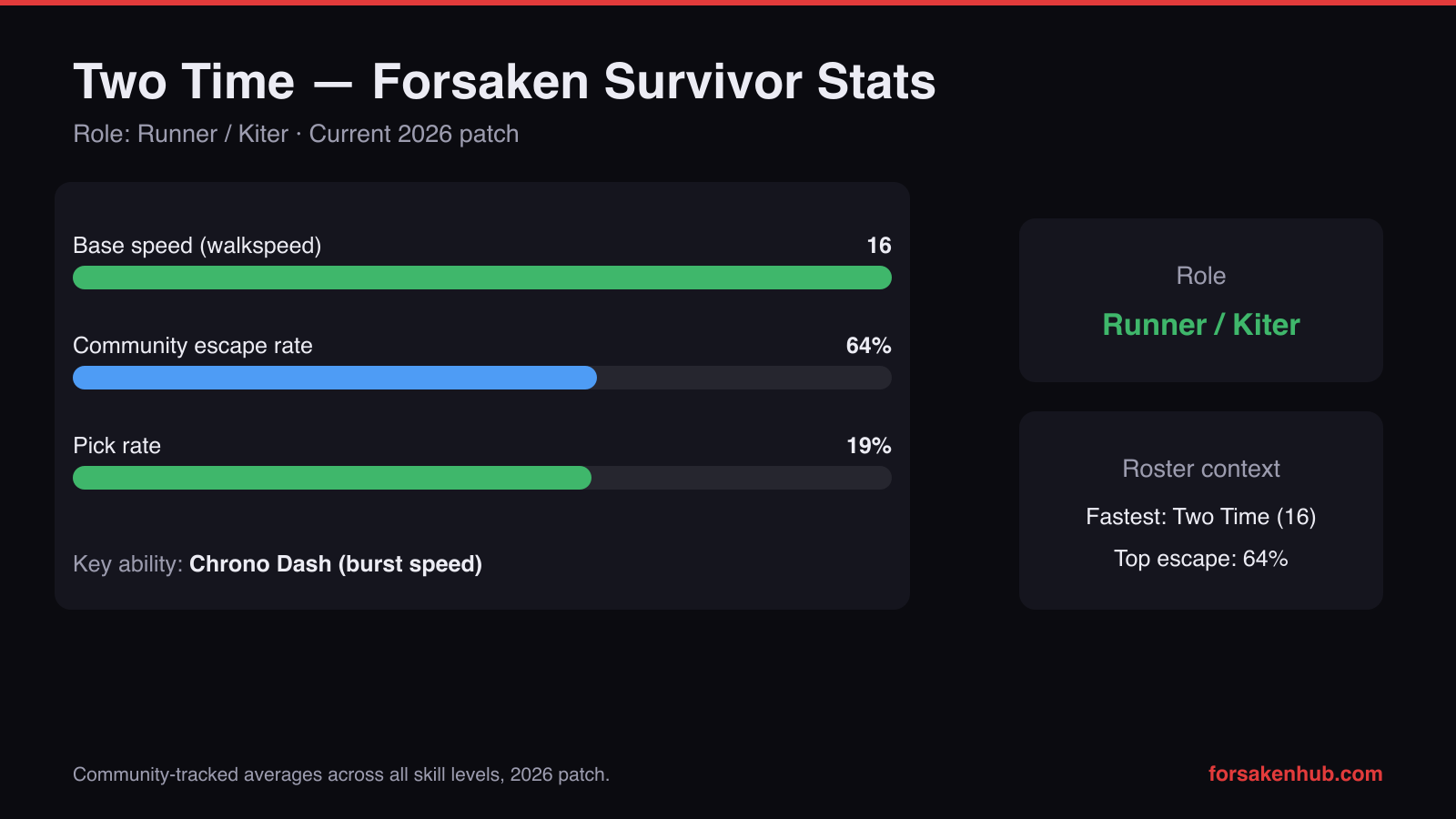
Two Time's stats from the Official Forsaken Wiki (September 2026) — two lives, not two speeds. Chart by ForsakenHub.
Final Thoughts
Two Time is a clutch character, but clutch doesn’t mean chaos. Plan your spend, trade only when the payoff is real, and you’ll consistently turn losing situations into resets and escapes.
- • Spend the second life only for a save, a finish, or an escape.
- • Avoid midgame “random chase” spends with no objective value.
- • Use simple callouts so teammates capitalize on your trade.
- • In endgame, trade once—don’t chain-die.
Next keyword posts: Elliot, Shedletsky, Jason, coolkid, Noob, and 007n7.
The Sacrificial Dagger economy
Two Time is a Sentinel Survivor costing 500 Player Points, and the kit is unusually explicit about its rewards. The Sacrificial Dagger stuns the Killer on a backstab, and the game pays differently depending on how you land it: stabbing the Killer awards 5 Player Points, 15 EXP and 0.25 Malice, while a backstab specifically awards 5 Player Points, 15 EXP and 0.75 Malice. That threefold Malice difference is the entire skill expression of the character. Two Time also converts successful play into health and a second life, which is what earns the Sentinel label.
A front-facing stab and a backstab pay the same currency and EXP but very different Malice. If you are playing Two Time to progress rather than to survive a particular round, positioning for the back angle is worth taking a risk for in a way that a plain stab is not.
As with every Sentinel, the stun is really a transfer of seconds from the killer to whoever is on a generator. Each completed puzzle layer removes three seconds from the four-minute round and a finished generator removes twelve, so a well-timed stun on a killer who was about to interrupt a puzzle is worth more than one used to save yourself from a chase you could have run out.
Positioning for the back angle
Because a backstab pays 0.75 Malice against 0.25 for a front stab — with both paying 5 Player Points and 15 EXP — Two Time is one of the few characters where the game explicitly rewards a harder version of the same action. That makes positioning, not aggression, the skill. Approaching a killer who is committed to chasing somebody else is the reliable way to get the angle; approaching one who is aware of you generally is not.
A stun transfers seconds from killer pressure into generator progress, and generator progress is the clock: three seconds per layer, twelve per completed generator, sixty for all five in a four-minute round. Player Points come only from public matchmaking, and they come from contribution rather than survival time — a generator puzzle layer pays 5 Player Points and 15 EXP, and a generator is four layers deep. Private servers award nothing at all, which makes them a place to rehearse rather than a place to grind.
What the stun is buying
The Sacrificial Dagger pays in Malice, but its real value is measured on the clock.
A round is four minutes long. Survivors win by outlasting it and killers extend it by eliminating people, so the only lever survivors control is the generators. On most maps there are five, each a Numberlink wire puzzle four layers deep. A completed layer removes three seconds from the clock and pays 5 Player Points and 15 EXP; a finished generator removes twelve seconds; clearing all five removes a full minute. The puzzle regenerates if you are interrupted, so unbanked layers are lost entirely rather than paused. The one map without generators is SFOTH, a private-server-only map with no objectives at all, so in public matchmaking every map has generators to work; Generator Hell, also private-server-only, uses an older square-flipping generator design.
Player Points come only from public matchmaking and are paid for contribution rather than survival time. Private servers award nothing at all, which makes them the right place to learn map geometry and ability timings and the wrong place to grind. EXP is tracked separately, per character, and unlocks a milestone Skin for that character at level 25, continuing to a cap at level 100, so playing one character builds skins while playing many builds roster breadth.
Last Man Standing is the phase most guides skip. When one survivor remains the timer resets to 1 minute 14 seconds, the music changes, and both players are highlighted to each other for six seconds. Every plan that depended on concealment stops working at that moment, on every map. Abilities held back for a dramatic finish are usually abilities wasted.
Related Forsaken Guides
Todos los Mapas de Forsaken 2026 - Nombres, Layouts y Estrategias
Lista completa de todos los mapas de Forsaken Roblox en 2026. Nombres, layouts, ubicaciones de generadores y estrategias para cada mapa.
Lista de Killers de Forsaken 2026 - Habilidades y Estadisticas
Lista completa de todos los killers de Forsaken con habilidades, estadisticas y consejos. Guia en espanol actualizada para 2026.
Forsaken Map Rotation 2026: How the System Works + What's Active
Forsaken map rotation 2026: how the queue picks maps, the current 14-map roster, observed frequencies, seasonal events, and how to predict your next map.
Forsaken Folder Locations: All 3 Folders for John Doe Unlock (2026)
Where are the 3 folders in Forsaken? Complete folder spawn pools per map, John Doe unlock walkthrough, and answers to 8 most-asked folder questions.
Forsaken Survivors List 2026: All 10 Ranked + Stats & Roles
Forsaken survivors list 2026: all 10 survivors with base speed, HP, role, difficulty, and tier — plus the fastest, the best support, and the beginner pick.
Back to the ForsakenHub homepage for the full Forsaken Roblox guide hub, or browse all guides. You can also play the game directly on Forsaken on Roblox.