Haunted Mansion Map Guide - Forsaken Roblox (2026)
Navigate the Haunted Mansion map in Forsaken. Learn room connections, secret passages, generator spawns, and how to survive this spooky map.
Haunted Mansion is the only three-floor map in Forsaken with functional secret passages that completely rewrite vertical chase dynamics creating an environment where survivors who master the hidden routes consistently outperform those relying on standard chase mechanics by 25-30% in escape rate. This gothic mansion features a grand ground floor with ballroom, library, and dining halls, a second floor of bedrooms and galleries connected by multiple staircases, and a creaking attic level with rafters and storage that provide unique elevated gameplay. Most critically, Haunted Mansion contains 6 secret passages hidden behind bookshelves, paintings, and fireplace mantels that allow instant floor transitions invisible to the killer, creating disappearing acts that make survivors functionally untraceable when used correctly. The map's atmospheric design includes cobwebs, flickering candelabras, creaking floorboards, and ghostly ambient sounds that add both immersion and tactical audio complexity. Players who approach Haunted Mansion without learning its secret passages average 34% escape rates, while passage-savvy survivors maintain 58-62% rates through superior vertical mobility and chase-breaking capability. This guide reveals every secret passage location, floor layout, generator position, and advanced technique needed to haunt the killer rather than be haunted yourself. For an overview of all Forsaken maps, visit /forsaken-maps.
Quick Stats: Haunted Mansion
- • Map Size: Large (10,500 sq studs across 3 floors)
- • Difficulty: Expert
- • Generators: 7 spawns, 5 required
- • Cover spots: 11-13 spawns
- • Floors: 3 (Ground, Upper, Attic)
- • Secret Passages: 6 hidden connections
- • Best For: Vertical gameplay and secret passage mastery
- • Killer Win Rate: 51% (balanced)
Haunted Mansion Floor-by-Floor Layout
Haunted Mansion is structured as a Victorian gothic estate with three distinct floors connected by two main staircases, a servants' stairwell, and the six secret passages that provide hidden floor transitions. Each floor has a unique architectural identity with different room types, loop structures, and atmospheric elements. The ground floor features grand rooms with high ceilings and wide doorways, the second floor has narrower corridors with bedroom-sized rooms, and the attic provides open rafter gameplay with exposed beams and storage clutter. Understanding each floor's strengths and weaknesses determines your routing decisions during every phase of the match.
1 - Ground Floor - Grand Hall and Living Spaces
The ground floor contains the map's largest rooms and strongest loop structures:
- •Grand Ballroom: The centerpiece of the mansion measuring 24x20 studs with a polished floor, chandelier, and raised stage at one end. The ballroom provides the map's best loop through the stage-to-pillar circuit where survivors circle stage stairs, dance floor obstacles, and decorative pillars. Chase time: 30-45 seconds with direction changes. Contains a guaranteed cover spot at the stage stairs and a generator spawn 50% of the time near the musician's alcove.
- •Library: A two-story room with floor-to-ceiling bookshelves, reading tables, and a rolling ladder on rails. The reading table creates a medium loop (12-15 seconds) while bookshelves provide line-of-sight breaks every 6-8 studs. The library contains SECRET PASSAGE #1: a bookshelf that swings open connecting to the second-floor study. Contains a generator spawn 40% of the time and a cover spot at the library entrance.
- •Dining Hall: Long room with a massive dining table and 12 chairs creating a linear loop where survivors run the table length using chairs as minor obstacles. The dining table loop provides 10-15 seconds of chase time. The dining hall contains SECRET PASSAGE #2: a hidden door behind a portrait leading to the second-floor guest bedroom. Contains a generator spawn 30% of the time.
- •Kitchen: Medium room with a center island counter (similar to Reborn Family Abode) providing a tight loop structure. The kitchen island loop generates 10-12 seconds of chase time with direction change potential. The kitchen connects to the dining hall, servants' passage, and the back door leading to the small courtyard. Contains a cover spot at the servants' passage entrance.
- •Main Foyer: The mansion entrance hall with a grand staircase splitting into two ascending paths to the second floor. The foyer staircase is the primary vertical transit between ground and second floor. The staircase split allows a 50-50 mindgame where survivors choose left or right ascending path while the killer commits to one side. Contains a decorative table providing a weak loop (5-8 seconds).
- •Parlor: A sitting room with armchairs, a fireplace, and display cabinets creating cluttered obstacles. The parlor contains SECRET PASSAGE #3: the fireplace mantel opens to reveal a hidden stairway leading to the attic. This is the fastest ground-to-attic transit on the map bypassing the second floor entirely. The parlor has minimal loop structures but its secret passage makes it strategically invaluable.
- •Servants' Quarters: A small room off the kitchen containing the servants' stairwell (connecting all three floors), a cot, and storage. The servants' stairwell is narrower than the main staircase but provides a less visible vertical transit route. Contains a generator spawn 30% of the time.
- •Courtyard: A small outdoor area behind the kitchen with a fountain and garden wall. The fountain creates a medium outdoor loop (15-20 seconds) and the garden wall provides the map's only outdoor cover. An escape window spawns in the courtyard wall.
2 - Second Floor - Bedrooms and Gallery
The second floor features a central corridor connecting bedroom suites and the art gallery:
- •Master Suite: The largest second-floor room containing a canopy bed, wardrobe, vanity, and bathroom alcove. The canopy bed provides a medium loop (10-12 seconds) using the bed frame posts as obstacles. The master suite contains SECRET PASSAGE #4: a wardrobe door that opens into a hidden stairway to the attic storage room, functioning identically to classic wardrobe secret passages. Contains a generator spawn 50% of the time near the vanity.
- •Guest Bedrooms (2): Two identical medium rooms with single beds, side tables, and dressers. Each guest bedroom provides weak loops (6-8 seconds) around the bed. The eastern guest bedroom connects to the dining hall via Secret Passage #2 (portrait door). Guest bedrooms contain a combined 40% generator spawn chance and one cover spot spawns between them.
- •Art Gallery: A long corridor-like room with paintings, sculptures, and display cases. The gallery provides extended line-of-sight breaks through sculpture positioning every 8-10 studs creating a unique chase dynamic where survivors weave between art pieces forcing killers into wider pathing. Contains SECRET PASSAGE #5: a large painting that swings open revealing a hidden slide to the ground floor foyer closet. This one-way passage provides emergency escape from the second floor. The gallery has a cover spot at the corridor entrance.
- •Study: A medium room with a large desk, bookshelves, and a globe creating cluttered obstacles. The study connects to the library via Secret Passage #1 (bookshelf). The desk provides a weak-medium loop (8-10 seconds). Contains a generator spawn 40% of the time near the bookshelves.
- •Second Floor Hallway: A 6-stud-wide corridor connecting all second-floor rooms with both staircase landings visible from either end. The hallway contains portrait frames and side tables as minor obstacles but no significant loop structures. Two cover spots spawn in the hallway: one near the main staircase landing and one near the servants' stairwell.
- •Balcony: An exterior platform accessible from the master suite offering a view of the courtyard below. The balcony provides a controlled drop to the courtyard (minor fall damage) creating a vertical escape route. During endgame, the balcony drop provides a direct escape to the courtyard escape window if it spawns below.
3 - Attic Floor - Rafters and Storage
The attic features an open layout with exposed rafters, storage clusters, and unique elevated gameplay:
- •Main Attic Space: An open area with exposed roof beams, support columns, and scattered furniture under dust covers creating a cluttered environment. The attic's open layout provides long sightlines but the column and furniture placement creates multiple line-of-sight breaks. The attic has reduced lighting (40% visibility) from small dormer windows creating a darker atmosphere than lower floors.
- •Storage Clusters: Three groupings of stacked boxes, trunks, and old furniture creating maze-like sections with narrow pathways. Each cluster provides 10-15 seconds of chase time through tight pathing between stored items. The clusters connect to each other through gaps that survivors can navigate faster than killers due to smaller hitboxes.
- •Rafter Walkways: Exposed roof rafters create elevated narrow walkways (3-4 studs wide) above the main attic floor. Survivors on rafters gain height advantage and can drop down to break chase. Rafter transitions provide 4-6 seconds of distance gain as killers must navigate to rafter access points. Contains SECRET PASSAGE #6: a loose floorboard on the rafters that drops survivors through a hidden chute to the ground floor parlor (near Secret Passage #3), creating an instant attic-to-ground-floor escape.
- •Attic Workshop: A small area with a workbench and tools providing a weak loop structure. Contains a generator spawn 50% of the time. The workshop connects to the attic via the main space and to the second floor via the master suite wardrobe passage (Secret Passage #4).
- •Servants' Stairwell Access: The servants' stairwell terminates in the attic near the storage clusters, providing the most direct route between attic and lower floors for survivors who prefer standard transit over secret passages.
- •Attic Cover spots: Two cover spots spawn in the attic: one guaranteed at the servants' stairwell entrance and one 50% chance between storage clusters. These cover spots are high-value because the attic's open layout otherwise provides limited defensive resources.
- •Basement Access: The basement spawns beneath the mansion accessible through a trapdoor in the kitchen floor. The basement contains a wine cellar layout with bottle racks providing moderate loops. The single trapdoor entrance makes basement eliminations extremely dangerous to rescue from, requiring secret passage knowledge to approach undetected.
Secret Passage Mastery Guide
The six secret passages are the defining feature of Haunted Mansion and the single most important mechanic to master for consistent escape. Each passage provides a hidden floor transition that the killer cannot follow through or see you use if line of sight is broken before entry. When a survivor activates a secret passage, they enter a brief 1.5-second transition animation during which they are invisible and invulnerable, emerging on the destination floor with zero scratch marks and no audio cue. This means a perfectly executed secret passage escape is a guaranteed chase break that no killer can counter regardless of ability or skill level.
Secret Passage Locations and Connections
Complete map of all six secret passages:
- •Passage #1 - Library Bookshelf (Ground to Second): Located on the back wall of the library behind the tallest bookshelf. Interact to swing the shelf open and emerge in the second-floor study. Bidirectional: works from study to library as well. Best used during library chases when line of sight breaks behind reading tables allow undetected entry.
- •Passage #2 - Dining Hall Portrait (Ground to Second): A large portrait of the mansion's original owner on the dining hall east wall. Interact to swing the portrait open revealing a narrow stairway to the eastern guest bedroom. Bidirectional. Best used when chased through the dining hall, breaking line of sight behind the dining table before entering.
- •Passage #3 - Parlor Fireplace (Ground to Attic): The parlor fireplace mantel contains a hidden lever. Interact to open the fireplace back wall revealing a vertical shaft to the attic. Bidirectional. This is the most valuable passage because it skips the second floor entirely, connecting the ground floor directly to the attic in 1.5 seconds versus 8-10 seconds via staircases.
- •Passage #4 - Master Suite Wardrobe (Second to Attic): The wardrobe in the master suite's corner opens into a hidden stairway to the attic workshop. Bidirectional. Best used during second-floor chases when the killer commits to the hallway approach while you enter the wardrobe from the master suite interior.
- •Passage #5 - Gallery Painting (Second to Ground, One-Way): A large painting in the art gallery swings open to reveal a slide that deposits survivors in the ground floor foyer closet. One-way only (second to ground). This emergency escape provides instant second-floor exit when all other escape routes are cut off. The slide emerges in the foyer closet with the door closed, providing immediate stealth upon arrival.
- •Passage #6 - Rafter Floorboard (Attic to Ground, One-Way): A loose floorboard on the attic rafters drops survivors through a hidden chute to the ground floor parlor. One-way only (attic to ground). This passage provides instant attic escape when the killer corners you on the rafters. The chute deposits you near the parlor fireplace (Passage #3), allowing immediate re-ascent to the attic if needed.
- •Passage Usage Rules: All passages require 1.5 seconds of interaction to activate. You must break line of sight before entering or the killer will see your destination and predict your location. Never use a passage when the killer is within 10 studs and has direct line of sight. The passage animation leaves you vulnerable during the 1.5-second interaction period.
Advanced Passage Techniques
Elite usage of secret passages for maximum chase-breaking effectiveness:
- •Double Passage Escape: Use Passage #6 (attic rafter to parlor) then immediately use Passage #3 (parlor fireplace to attic) to return to the attic. This double-passage creates a round trip that wastes 15-20 seconds of killer time as they search the ground floor while you resume attic activity. Works because the killer expects you to stay on the destination floor.
- •Passage Chain Routing: Plan chase routes through rooms containing passages. When chased on the ground floor, route through the library (Passage #1) to reach the second-floor study, then through the gallery (Passage #5) to slide back to the ground floor foyer. This passage chain covers three floors in 10 seconds while the killer must navigate staircases.
- •Fake Passage Entry: Run toward a passage location, create scratch marks leading to it, then quietly walk away in a different direction. The killer checks the passage destination floor while you remain on the current floor with a 10-15 second tracking lead. This technique requires line-of-sight break before the fake-out to be effective.
- •Passage Camping: During stealth play, position yourself near a passage entrance with the passage pre-selected for instant activation. If the killer discovers you, immediately enter the passage for guaranteed escape. The 1.5-second activation time is faster than killer approach from detection range (16+ studs).
- •Post-Revive Passage: After revive a teammate, immediately use the nearest passage to escape the elimination floor. Killers who patrol eliminations expect rescuers to use staircases; passage exits create confusion about rescuer direction allowing both rescued and rescuer to escape safely.
Pro Tip
Before playing Haunted Mansion competitively, memorize all six secret passage locations and their connections. The three bidirectional passages (library-study, dining-guest bedroom, parlor-attic) and two one-way passages (gallery-foyer, rafter-parlor) plus the fireplace passage form a complete vertical mobility network. Spend one custom match (10-15 minutes) walking between all passages practicing activation until the locations become automatic. This single practice session improves your Haunted Mansion escape rate by 20-25% immediately through chase-breaking capability that no other map mechanic provides.
Generator Strategy for Haunted Mansion
Generator strategy on Haunted Mansion requires managing the three-floor vertical distribution that creates unique 3-gen scenarios impossible on single-floor maps. A vertical 3-gen where the remaining generators stack directly above each other on different floors allows killers to patrol using staircases with 8-10 second rotation times between floors. Preventing vertical 3-gen requires completing at least one generator per floor before your fourth total completion, ensuring the remaining generators spread across multiple floors and horizontal positions.
Generator Priority by Floor
Balance completions across all three floors:
- •Priority 1 - Attic Generators: Complete attic generators first (attic workshop and storage area spawns). The attic's reduced lighting and limited loop structures make it the most dangerous repair location during late game. Early attic completion eliminates the need to climb to the highest floor under pressure.
- •Priority 2 - Isolated Second Floor Generators: Complete generators in the guest bedrooms and study before the master suite. These rooms have weaker loops and more limited escape options, making them dangerous late-game targets. The master suite generator benefits from Secret Passage #4 proximity and the bed loop, making it safer for later completion.
- •Priority 3 - Ground Floor Dangerous Generators: Complete the dining hall and servants' quarters generators mid-game. The dining hall has a weak loop but Secret Passage #2 provides escape insurance. The servants' quarters generator has no nearby loop making it a complete reliance on the servants' stairwell for escape.
- •Priority 4 - Ground Floor Safe Generators Last: Save the ballroom and library generators for final completions. The ballroom provides the strongest loop on the map (30-45 second stage circuit) and the library offers Secret Passage #1 for escape, making both ideal late-game repair positions under maximum killer pressure.
- •Vertical 3-Gen Prevention: Never leave remaining generators stacked vertically. If your second-floor master suite generator is directly above the ground-floor parlor generator, complete one of them before your fourth total to prevent the killer from patrolling vertically between them in 6-8 seconds via staircase.
- •Secret Passage Generator Priority: Generators near secret passages gain significant safety value. Prioritize non-passage generators for early completion and save passage-adjacent generators for late game when the escape insurance of nearby passages becomes critical.
- •Floor Patrol Timing: Killer rotation between floors takes 8-10 seconds via staircases. When the killer descends to the ground floor, you have 16-20 seconds of safe second-floor repair time (8-10 seconds down plus 8-10 seconds back up). Time your repair sessions to these vertical patrol windows.
Chase Mechanics and Vertical Looping
Haunted Mansion chases operate in three dimensions rather than the standard two. Traditional maps restrict chase to a single horizontal plane, but Haunted Mansion's three floors, multiple staircases, and secret passages create vertical chase dynamics where survivors can gain or lose advantage by changing floors mid-chase. The strongest Haunted Mansion survivors treat vertical transitions as their primary chase-extension tool, changing floors every 15-20 seconds to reset bloodlust and force killers into constant staircase rotations that waste enormous amounts of time.
Floor-Specific Chase Strategies
Optimal chase behavior on each floor:
- •Ground Floor Chase: Route to the ballroom immediately. The stage-pillar circuit provides 30-45 seconds of looping before resources deplete. After ballroom resources are used, transition to the kitchen island loop for 10-12 additional seconds, then exit through the back door to the courtyard fountain loop for 15-20 outdoor seconds. This ground-floor chain provides 55-75 seconds of chase time.
- •Second Floor Chase: Route to the art gallery where sculptures provide line-of-sight breaks every 8-10 studs. Gallery chases extend 20-30 seconds through sculpture weaving. When the killer closes distance, use Secret Passage #5 (gallery painting slide) for instant ground-floor escape. Alternatively, route through the hallway using both hallway cover spots for 15-20 seconds before transitioning via staircase.
- •Attic Chase: Route to storage clusters where tight pathways between stored items provide 10-15 seconds of chase time per cluster. Transition between clusters using rafter walkways for 4-6 seconds of distance gain per rafter transition. When the attic becomes unsafe, use Secret Passage #6 (rafter floorboard) for instant ground-floor escape to the parlor.
- •Vertical Transition Timing: Change floors every 15-20 seconds of chase to reset killer bloodlust. Bloodlust requires continuous chase on the same floor to accumulate. Staircase transitions and secret passages both reset bloodlust, making vertical movement a hard counter to bloodlust-dependent killers.
- •Staircase 50-50: At the main staircase, the split into two ascending paths creates a 50-50 where you commit to left or right. The killer must guess correctly or lose 4-6 seconds routing to the opposite path. Execute this mindgame every time you transit the main staircase for consistent distance gains.
- •Servants' Stairwell Advantage: The servants' stairwell is narrower and less visible than the main staircase. Use the servants' stairwell for unexpected floor transitions when the killer expects you to use the main staircase. The servants' stairwell connects all three floors directly, making it the most efficient non-passage vertical transit.
Room-Specific Loop Details
Maximize chase time at each major room structure:
- •Ballroom Stage Circuit: Circle the raised stage using the stage stairs (both sides) and adjacent pillars. The stage height difference (3 studs) creates a vault point where survivors jump onto the stage while killers must path to the stairs. Each circuit takes 8-10 seconds with direction changes at pillar positions extending to 12-15 seconds per rotation.
- •Library Table Loop: The reading table provides a 12-15 second loop with bookshelves creating secondary obstacles. When the killer commits to one side of the table, the rolling bookshelf ladder can be used as a line-of-sight break by positioning it between you and the killer during shelf traversal.
- •Kitchen Island: Identical to standard island loops on other maps (10-12 seconds) with the added benefit of the back door exit to the courtyard when the island loop exhausts.
- •Canopy Bed Loop: The master suite canopy bed frame creates 10-12 second loops with the bed posts serving as line-of-sight breaks. Combine with the wardrobe Secret Passage #4 for instant attic escape when the loop becomes unsafe.
- •Gallery Sculpture Weave: Rather than looping a single sculpture, weave between 4-5 sculptures in sequence using each one for 3-4 seconds of line-of-sight break. This weaving technique provides 20-30 seconds of chase time with unpredictable pathing that killers struggle to cut off.
- •Storage Cluster Maze: Navigate tight gaps between stacked storage items. Your smaller hitbox passes through 3-4 stud gaps faster than the killer creating incremental distance advantage. Chain between three storage clusters for 30-40 seconds of attic chase time.
- •Courtyard Fountain: The outdoor fountain provides a standard 15-20 second loop with direction change potential. The courtyard's small size limits extended outdoor chase but the fountain loop provides reliable distance when indoor resources are depleted.
Killer-Specific Haunted Mansion Strategies
Haunted Mansion's multi-floor layout with secret passages creates unique killer matchup dynamics. Killers who rely on tracking and prediction lose significant effectiveness when survivors use passages to teleport between floors, while killers with multi-floor patrol abilities or aura reading partially counter the passage advantage. Understanding how each killer type interacts with the mansion's vertical design lets you optimize your passage usage and floor selection. Check our full killer guide at /forsaken-killers for ability specifics.
Killer Tier Shifts on Haunted Mansion
How the mansion environment affects killer effectiveness:
- •Stealth Killers (Weakened): The mansion's three floors and six passages mean stealth killers must patrol three times the area of single-floor maps. Their stealth approach is countered by passage escapes that do not require detecting the killer first. Additionally, the mansion's creaking floorboard sounds create ambient audio warnings of movement on adjacent floors. Stealth killers drop from S-tier to B-tier on Haunted Mansion.
- •Tracking Killers (Strong): Killers with aura reading abilities partially counter secret passages by revealing which floor survivors occupy after passage transit. Aura reading eliminates the guessing that makes passages effective. Against tracking killers, use passages more sparingly and rely on standard looping at the ballroom and gallery instead. Run Distortion ability to deny aura reads.
- •Trap Killers (Strong): The secret passage entrance and exit points create guaranteed trap locations. Trap killers who trap passage exits catch survivors in the 1.5-second emergence animation when they cannot dodge. Counter by checking passage exits before committing to passage transit and by using alternative passages when one is trapped.
- •Mobility Killers (Weakened): Dash and chainsaw abilities lose effectiveness in the mansion's cluttered rooms and narrow hallways. Staircase navigation prevents effective power usage during vertical chases. Mobility killers on Haunted Mansion function as standard M1 killers 60-70% of the time.
- •Ranged Killers (Mixed): The ballroom and gallery provide some ranged attack sightlines, but most mansion rooms are too cluttered for effective projectile usage. Ranged killers perform well in the open ground floor rooms but poorly on the cluttered second floor and attic.
- •Anti-Loop Killers (Weakened): Secret passages provide chase-breaking that anti-loop abilities cannot counter. Even if a killer counters every cover spot and window on the map, secret passages provide guaranteed escape independent of loop structures. Anti-loop killers lose their primary advantage against passage-savvy survivors.
- •Basement Campers (Devastating): Haunted Mansion's basement is accessible only through the kitchen trapdoor creating the most dangerous basement in Forsaken. The single access point through the cluttered kitchen makes rescue approaches visible from 15+ studs. Against basement-camping killers, accept the elimination rather than risk multiple survivors on dangerous rescue attempts.
Advanced Haunted Mansion Techniques
Elite Haunted Mansion players combine passage mastery with floor-specific knowledge to create gameplay that feels like the survivor has supernatural powers of their own. These advanced techniques leverage the unique combination of multi-floor architecture, hidden passages, atmospheric audio, and the mansion's distinctive room layouts to achieve escape rates that approach 60%+ through superior environmental exploitation.
Environmental and Audio Exploitation
Use the mansion's gothic atmosphere to your tactical advantage:
- •Floorboard Creaking Intelligence: Haunted Mansion's wooden floors create distinct creaking sounds when characters walk on them. Each floor has slightly different creak tones (ground floor = deep creaks, second floor = medium creaks, attic = high-pitched creaks). With headphones and practice, you can identify which floor the killer occupies through floorboard audio alone without visual contact or terror radius information.
- •Candelabra Light Manipulation: The mansion's flickering candelabra lights create alternating bright and shadow zones every 4-6 studs. During chases, route through shadow zones where flickering light makes your silhouette harder to track. When hiding, position in shadow zones where the inconsistent lighting reduces killer detection range by 20-30%.
- •Ambient Sound Masking: The mansion produces ambient sounds: wind through windows, creaking timber, and distant ghostly effects. These ambient sounds mask footsteps and generator repair audio within 8-10 studs of sound sources. Position generator repairs near ambient sound sources (windows, structural beams) for natural audio masking.
- •Dust Particle Tracking: Moving quickly through the attic disturbs visible dust particles that settle after 4-5 seconds. Experienced killers check for disturbed dust to track recent survivor movement in the attic. Walk slowly through the attic when stealth matters to minimize dust disturbance.
- •Portrait Eye Awareness: Several paintings in the gallery and hallways feature eyes that seem to follow movement. While this is atmospheric design, use these portraits as psychological anchors that remind you of nearby secret passage locations. The large portrait in the dining hall (Passage #2) and the gallery painting (Passage #5) both serve dual atmospheric and mechanical functions.
- •Storm Ambiance Exploitation: During the mansion's periodic thunder and lightning effects, the momentary bright flash illuminates the entire map for 0.5 seconds followed by 2-3 seconds of deepened darkness. Time passage entries during the post-flash darkness when visibility drops to minimum.
Team Strategies for Haunted Mansion
Coordinated play on the multi-floor mansion:
- •Floor Assignment Protocol: Assign two survivors to ground floor and two to upper floors (second floor and attic split). Each pair handles generators on their assigned floors while the other pair creates distraction or assists with chases. This prevents all four survivors from clustering on one floor leaving other floors' generators unattended.
- •Passage Information Sharing: When using secret passages during chase, call out your destination floor so teammates know to avoid that floor (preventing double-chase scenarios). Communication like "going up via library" tells teammates you are emerging in the second-floor study.
- •Rescue Passage Routes: For elimination rescues, use secret passages to approach the elimination floor without triggering killer awareness from staircase movement. The killer monitoring staircases for rescue approaches will miss survivors arriving via passage. Coordinate rescue timing with a distraction chase on a different floor.
- •Generator Pop Coordination: Completing generators on different floors simultaneously prevents the killer from immediately patrolling the completed generator area. Coordinate "3-2-1 pop" timing between floor teams for dual completions that create maximum confusion about which floor needs patrol attention.
- •Endgame Floor Control: During endgame, the courtyard escape window and the front entrance gate are both on the ground floor. Position survivors near both gates while one survivor loops the killer on the second floor or attic using passages to prevent the killer from reaching ground level where gates are opening.
Haunted Mansion Secret Passage Quick Reference
| Passage | Location | Destination | Direction | Best Use Case |
|---|---|---|---|---|
| #1 Bookshelf | Library (Ground) | Study (Second) | Bidirectional | Library chase escape |
| #2 Portrait | Dining Hall (Ground) | Guest Bedroom (Second) | Bidirectional | Dining chase escape |
| #3 Fireplace | Parlor (Ground) | Attic (Third) | Bidirectional | Skip second floor entirely |
| #4 Wardrobe | Master Suite (Second) | Attic Workshop (Third) | Bidirectional | Second floor chase escape |
| #5 Painting | Gallery (Second) | Foyer Closet (Ground) | One-Way Down | Emergency second floor exit |
| #6 Floorboard | Attic Rafters (Third) | Parlor (Ground) | One-Way Down | Attic emergency escape |
Passage Overreliance Warning
While secret passages are Haunted Mansion's most powerful survivor tool, over-relying on passages creates predictable patterns that experienced killers exploit. A killer who notices you entering the library during every chase will begin pre-patrolling the second-floor study to catch your passage exit. Vary your passage usage between all six routes and mix passage escapes with standard staircase transitions to remain unpredictable. The ideal ratio is 60% standard chases and 40% passage escapes, keeping the killer guessing about which method you will use on any given chase.
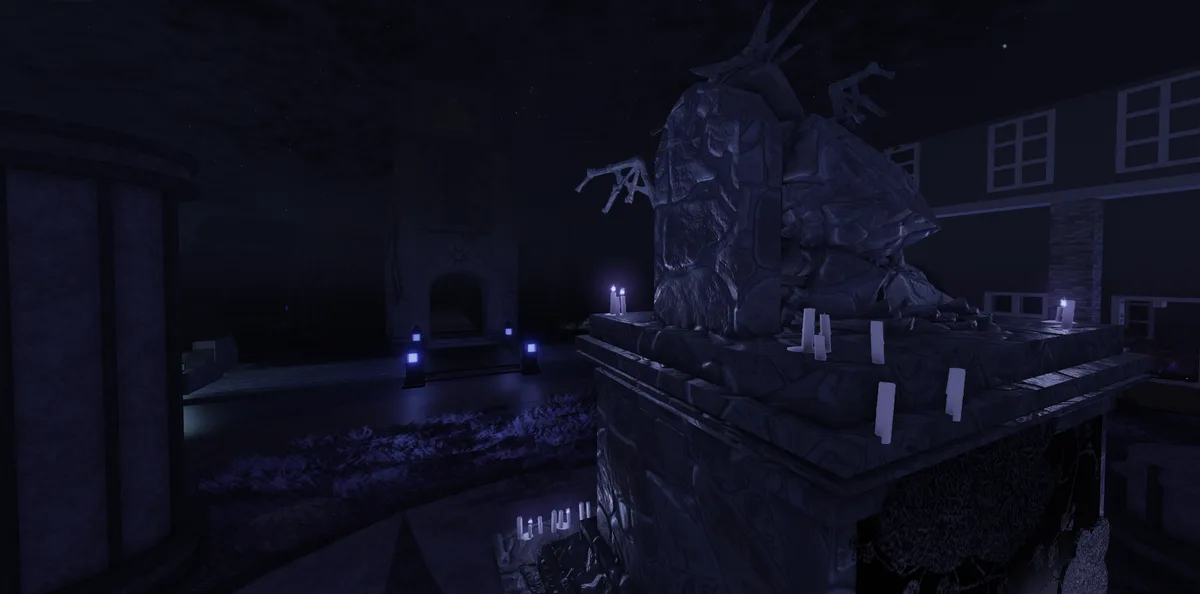
In-game view of Reborn Family Abode in Forsaken. Image: Forsaken (Roblox) © Forsaken Dev Group, via the Official Forsaken Wiki (forsaken.wiki).
Final Thoughts
Haunted Mansion rewards a unique skill set that combines traditional Forsaken chase mechanics with vertical three-dimensional thinking and secret passage mastery that exists on no other map. The survivors who excel here are those who think in three dimensions at all times, tracking the killer's floor position through audio cues while maintaining mental maps of nearby passage locations for instant escape. The map's balanced 51% killer win rate reflects the powerful tools available to both sides: killers get a massive multi-floor patrol area with atmospheric darkness, while survivors get six secret passages that provide chase-breaking capability unmatched by any other map mechanic. Your path to Haunted Mansion mastery follows three stages. First, spend 2-3 custom matches learning the physical layout of all three floors and memorizing every secret passage location and connection. Second, practice passage transit during active chases over 10-15 real matches, developing the instinct for when to use passages versus standard escape. Third, implement the generator floor-balancing strategy and vertical chase techniques over 30-50 matches, tracking your escape rate improvement. Players who complete this progression typically see their Haunted Mansion escape rate climb from 34% to 55-60%, with the secret passage mastery alone accounting for 15-20% of that improvement. Haunted Mansion is not just a map to survive; it is a map to master, and mastering it makes you a more complete Forsaken player across every environment.
- • Haunted Mansion is the only three-floor map in Forsaken with 6 secret passages that provide chase-breaking floor transitions invisible to the killer
- • The grand ballroom stage circuit is the strongest loop on the map providing 30-45 seconds of chase time through stage height advantage and pillar obstacles
- • Complete attic generators first to eliminate the most dangerous repair floor from late-game pressure then work downward through the mansion
- • Secret passages require 1.5 seconds to activate and demand line-of-sight break before entry to prevent killers from predicting your destination floor
- • Vertical chase transitions reset killer bloodlust making floor changes every 15-20 seconds a hard counter to bloodlust-dependent killers
- • Tracking killers with aura reading partially counter passage escapes so run Distortion ability and rely more on standard looping against these killers
- • Mix passage escapes (40%) with standard staircase transitions (60%) to prevent predictable patterns that experienced killers exploit
Load a custom Haunted Mansion match and practice using all six secret passages in sequence: library bookshelf to study, dining portrait to guest bedroom, parlor fireplace to attic, master wardrobe to workshop, gallery painting to foyer, and rafter floorboard to parlor. Time yourself completing the full passage circuit until you can hit all six within 3 minutes. This practice creates the muscle memory foundation for every Haunted Mansion escape strategy in this guide.
Related Forsaken Guides
All 12 Forsaken Killers & Abilities 2026: Stats, Counters, Tier
Every Forsaken killer in 2026: all 12 rosters, every ability with cooldowns, base speed + HP, S-tier ranking, and the survivor that hard-counters each one.
All Forsaken Maps 2026: Every Map Ranked, Layouts & Loop Spots
Every Forsaken map in 2026: full roster ranked easiest to hardest, generator + cover + window locations, best loops, and rotation schedule.
Forsaken Game Mechanics Guide 2026 - Timer, Generators & Items
Complete guide to every Forsaken game mechanic: eliminations, cover, windows, generators, stamina, skill checks, the round timer, and win conditions explained.
Forsaken Controls & Keybinds Guide - PC, Mobile & Console (2026)
Complete Forsaken controls guide for PC, mobile, and console. All keybinds, button layouts, and custom settings to optimize your gameplay.
Best Forsaken Settings 2026 - FPS Boost, Lag Fix & System Requirements
Optimize Forsaken with the best settings for maximum FPS. Fix lag, reduce stuttering, and meet system requirements. Works on low-end PC and mobile.
Back to the ForsakenHub homepage for the full Forsaken Roblox guide hub, or browse all guides. You can also play the game directly on Forsaken on Roblox.