Elliot in Forsaken: Support Guide, Reset Positioning & Meta Matchups (2026)
Play Elliot like a high-elo support: where to stand, when to heal, and how to stabilize solo queue without hovering or wasting tempo.
Elliot is Forsaken’s “team tempo” support survivor: you win matches by turning small moments (a heal window, a safe rotation, a fast reset) into huge map pressure. Elliot is often recommended to new players because the kit feels supportive and forgiving—but that’s exactly why experienced teams love him too. A strong Elliot makes the lobby feel “un-hookable” because resets happen fast and information stays clear. This guide focuses on high-value Elliot play: where to stand during chases, how to time your support tools so they matter, and how to avoid the two habits that make Elliot feel weak (hovering and over-healing).
Quick Stats: Elliot (Playstyle Summary)
- • Role: Support / tempo
- • Strength: Faster, cleaner resets for the whole team
- • Best Use Case: Solo queue consistency + coordinated team snowball
- • Best Pairings: Another support (Chance/Two Time) or a strong looper
- • Biggest Weakness: “Hovering” eliminations without committing to progress
- • Skill Test: Timing—using support tools at the moment they matter
Notice how good Elliot players spend most of the match positioning and rotating, not just healing.
Elliot Job Table (What You Should Be Doing)
Elliot’s value is “doing the right job at the right time.” Use this as your decision anchor.
| Match State | Your Job | Where You Stand | What You Avoid |
|---|---|---|---|
| Teammate in chase (healthy) | Objective tempo | Near a safe rotation lane, not inside the chase tile | Running into the chase and giving the killer two targets |
| Teammate in chase (injured) | Prepare reset + information | Between the chase tile and a safe heal spot | Hovering the elimination area before anyone is downed |
| Elimination just happened | Decide: commit save or commit progress | At a rescue approach line with cover (or on a separate objective) | “Maybe saving” while also not progressing anything |
| Two+ teammates injured | Stabilize lobby state | Safe heal zone, then split again | Greedy objective taps that lead to chain downs |
| Endgame | Trade plan + clean escape | Gate-side cover and safe rotation | Panic rescues without a leave condition |
If you want to be a high-value Elliot: never “float.” Either progress something, or commit to a save with a plan.
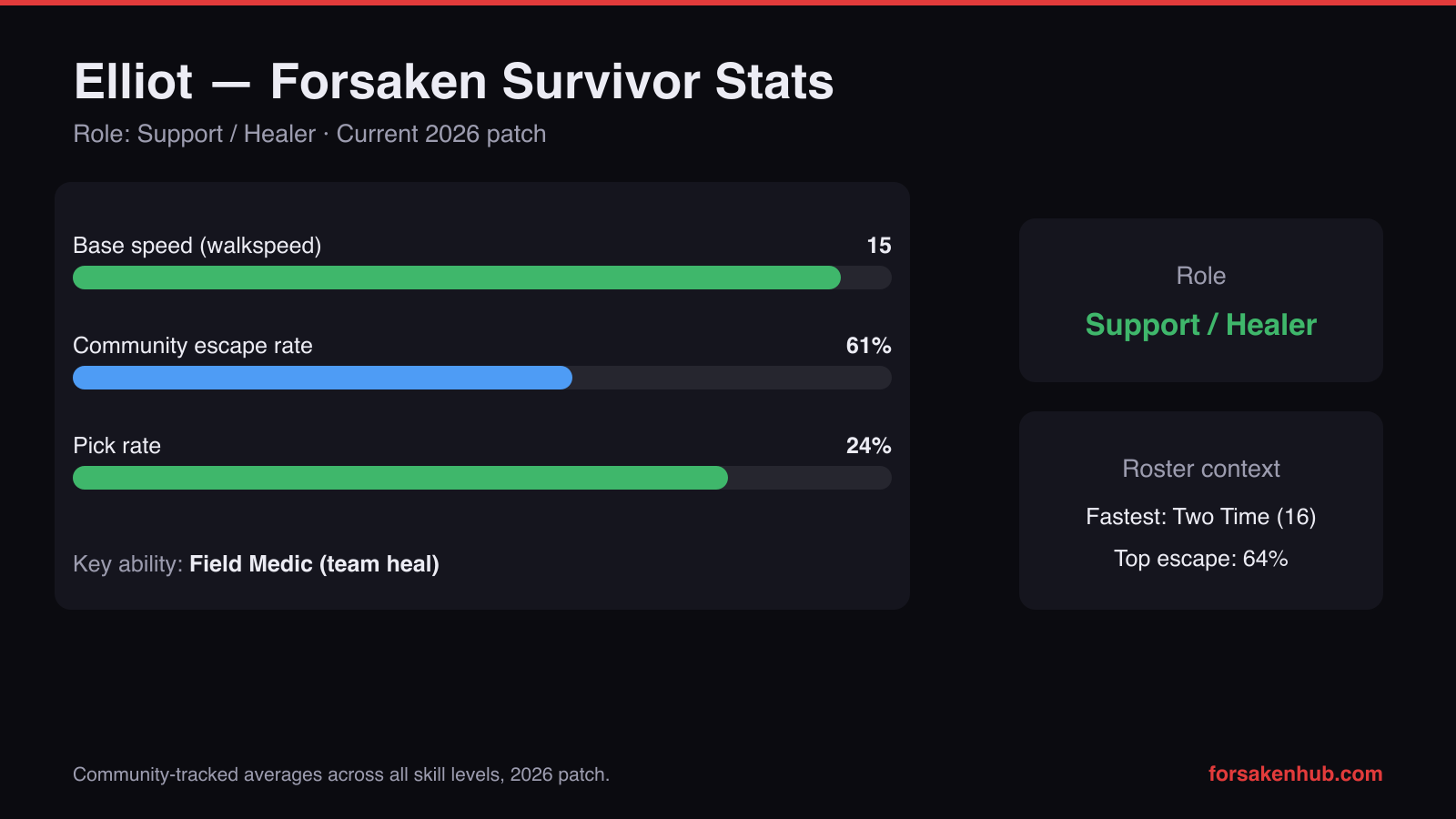
Elliot's stats from the Official Forsaken Wiki (September 2026). Chart by ForsakenHub.
High-Value Elliot Play (3 Principles)
Elliot is not complicated mechanically. The skill is making the team’s next 30 seconds cleaner than the killer expects.
1) Position for the Reset, Not the Chase
Most support players waste time by running into the chase tile. Elliot is strongest when you are the “reset station”.
- •Stand one tile away from the chase so you can help after the hit, not before it.
- •Pick a heal zone with two exits and at least one hard line-of-sight break (a room corner or a stair area).
- •If the killer drops chase, you lose nothing—you’re already positioned to rotate back to objectives.
- •If the chase ends in a down, you’re already positioned to decide: save now or trade later.
- •This single habit makes solo queue lobbies feel dramatically more coordinated.
2) Don’t Over-Heal (Heal Just Enough)
Elliot wins by tempo. Tempo dies when everyone spends 30 seconds doing a “perfect” heal at the wrong time.
- •If the killer is far, full resets are great—heal and then split immediately.
- •If the killer is nearby, prioritize distance and information: safe rotation first, heal second.
- •When two people heal one person, that’s often a mistake unless you are preventing a collapse.
- •Your goal is to keep at least two survivors productive most of the time.
- •If you can’t explain why you’re healing right now, you probably shouldn’t be.
3) Make Rescues Predictable for Your Team
Support is strongest when teammates know what you will do without guessing.
- •If you are going for the save, say it (or ping it) and commit; don’t hover.
- •If you are not going for the save, commit to progress and let someone else handle it.
- •If the killer is camping, coordinate a trade: one person baits, one saves, you reset the injured teammate.
- •Elliot’s biggest value is making “messy” rescues clean.
Elliot vs Meta Killers (How to Adapt)
Support play changes depending on how the killer creates pressure. Use these adaptations to stay valuable.
Against burst mobility killers (e.g., Nosferatu)
Your job is to avoid chain downs.
- •Heal in safer zones with multiple exits; don’t heal in open lanes where a dash can punish both survivors.
- •Split faster after reset; mobility killers punish clumps.
- •Prioritize information: if you don’t know where the killer is, assume they can arrive quickly.
- •If a teammate is injured and being chased, position for a trade rather than chasing for a heal.
Against setup/control killers (e.g., John Doe)
Your job is to avoid predictable rotations.
- •Rotate through different lanes each time so you don’t step into repeated trap patterns.
- •Heal away from common chokepoints and elimination approach lanes.
- •If a teammate is trapped in an area, don’t “stack” there—draw the killer away and reset elsewhere.
- •Call out trap zones if you see them; Elliot is a natural information anchor.
The Elliot Throw
If you spend the match hovering eliminations and healing at random, you become invisible value: you feel busy, but the team doesn’t progress. Commit to one job every minute—progress, rescue, or stabilize—and Elliot becomes one of the most consistent survivors in Forsaken.
Sources (Verify Live Values)
Elliot values and tooltips can change; verify in-game for the current patch. These references are useful starting points:
References
External links:
- •Forsaken (Roblox): https://www.roblox.com
- •Community Wiki (Forsaken2024): https://forsaken2024.fandom.com/wiki/Forsaken_Wiki
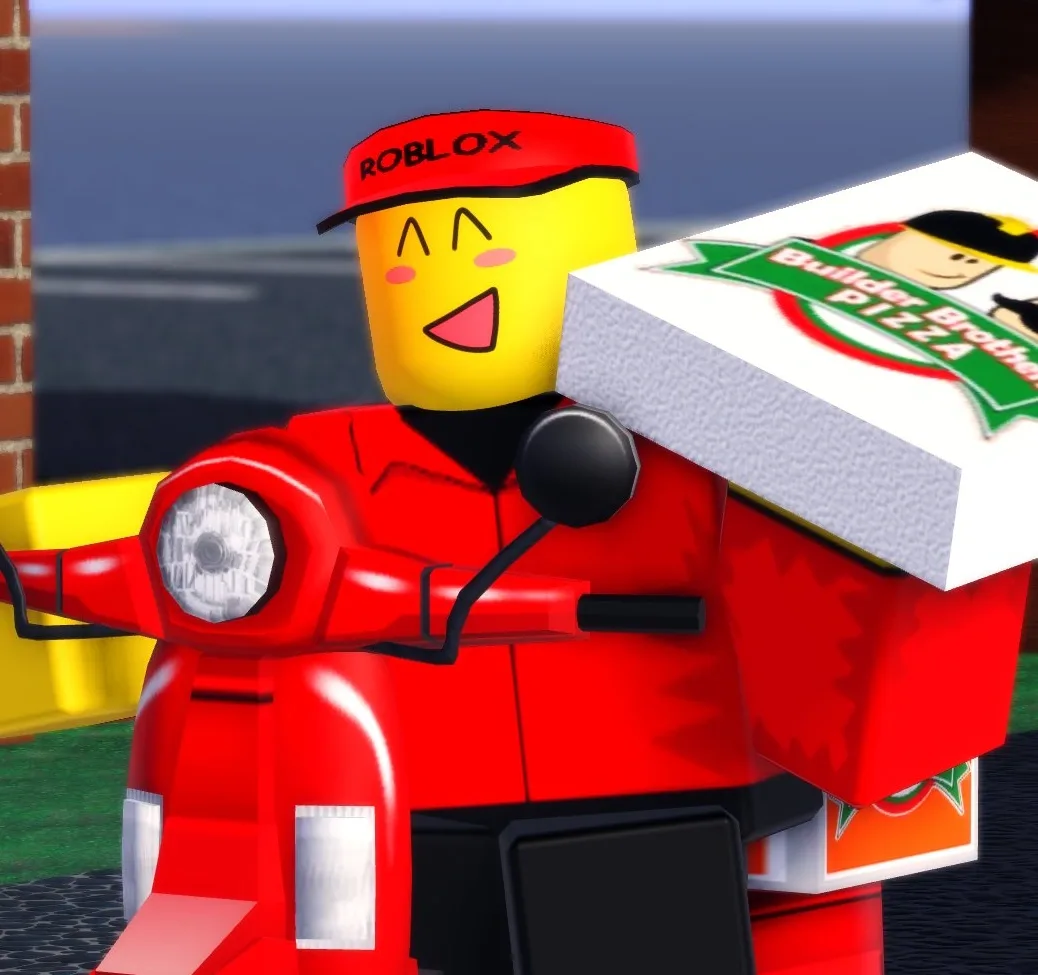
Elliot as they appear in Forsaken. Image: Forsaken (Roblox) © Forsaken Dev Group, via the FORSAKEN Wiki on Fandom.
Final Thoughts
Elliot is a tempo character. If you position for resets, heal only when it matters, and make your rescue decisions predictable, you’ll feel your team stop collapsing—even in solo queue.
- • Stand one tile away and be the reset station.
- • Heal just enough to keep tempo, not “perfectly” every time.
- • Commit to rescues with a plan; don’t hover.
- • Adapt your positioning to mobility vs control killers.
Next keyword posts: Shedletsky, Jason/Slasher, coolkid, 007n7, and Noob.
Support is the class that scales with your team
Elliot is the Support among the three free starter Survivors, running Pizza Throw and Rush Hour to heal and assist teammates quickly. He is based on Elliot Builder, the mascot of Work at a Pizza Place. Support is the one class whose value is almost entirely determined by what everyone else is doing: in a team that splits generators and takes chases, Elliot is excellent, and in a team where everyone hides he does close to nothing, because there is nobody to keep alive on an objective.
Priority goes to whoever is mid-generator, not to whoever is loudest. Generator progress is the clock: three seconds off per completed puzzle layer, twelve for a full generator, sixty if all five go down in a four-minute round. Keeping a teammate on a puzzle alive for another layer is worth more than a topped-up survivor with nothing to do.
Without coordination you cannot rely on anyone being where you expect, and Support suffers most from that. If your lobby is habitually solo, one of the Sentinels may serve you better, because a stun works regardless of whether anybody else is cooperating.
Reading who actually needs the heal
Support has a triage problem that the other classes do not. The correct target is almost never the loudest one: it is whoever can immediately return to a generator. Healing a survivor who is about to resume a puzzle converts directly into clock reduction at three seconds a layer, while healing one who is going to keep running converts into nothing measurable.
In a lobby without coordination, Support underperforms because there may be nobody holding an objective to protect. Shedletsky is free, plays as a Sentinel, and his Slash works regardless of what teammates do — a better default for solo queue. Player Points come only from public matchmaking, and they come from contribution rather than survival time — a generator puzzle layer pays 5 Player Points and 15 EXP, and a generator is four layers deep. Private servers award nothing at all, which makes them a place to rehearse rather than a place to grind.
Support inside the round economy
Healing converts into clock reduction only when the person you heal returns to an objective.
A round is four minutes long. Survivors win by outlasting it and killers extend it by eliminating people, so the only lever survivors control is the generators. On most maps there are five, each a Numberlink wire puzzle four layers deep. A completed layer removes three seconds from the clock and pays 5 Player Points and 15 EXP; a finished generator removes twelve seconds; clearing all five removes a full minute. The puzzle regenerates if you are interrupted, so unbanked layers are lost entirely rather than paused. The one map without generators is SFOTH, a private-server-only map with no objectives at all, so in public matchmaking every map has generators to work; Generator Hell, also private-server-only, uses an older square-flipping generator design.
The roster is fixed-ability rather than build-based. Survivors come in three classes: Survivalists Noob (free) and 007n7 (500 Player Points) look after themselves; Sentinels Shedletsky (free), Two Time and Guest 1337 (500 each) and Chance (777) interfere with the killer directly; and Elliot (free) is the only Support. Killers are c00lkidd and Slasher (both free), John Doe (1,000) and Noli (1,100). With no perks and no loadouts, picking a character is picking your role for the round, and nothing unlocked later changes how an existing character plays.
Player Points come only from public matchmaking and are paid for contribution rather than survival time. Private servers award nothing at all, which makes them the right place to learn map geometry and ability timings and the wrong place to grind. EXP is tracked separately, per character, and unlocks a milestone Skin for that character at level 25, continuing to a cap at level 100, so playing one character builds skins while playing many builds roster breadth.
Related Forsaken Guides
Shedletsky in Forsaken: Aggressive Support Guide, Stuns & Trades (2026)
High-value Shedletsky guide for Forsaken: how to time stuns, take correct trades, and use heals to end the crisis instead of feeding downs.
Jason (Slasher) in Forsaken: Killer Guide, Cooldown Timing & Endgame (2026)
Complete Slasher/Jason guide for Forsaken: Behead timing, Gashing Wound patterns, and repeatable chase sequences that stop long loops.
c00lkidd Forsaken Guide 2026: All Abilities, Best Skins & Counter
c00lkidd (coolkid) in Forsaken 2026: all 4 abilities ranked, the projectile combo that ends chases, top 3 skins, and the survivor who hard-counters.
Noob in Forsaken: Survival Guide, Item Timing & Cooldown Management (2026)
Noob guide for Forsaken: when to use Bloxy Cola, Slateskin, and Ghostburger so you stop wasting cooldowns and start escaping consistently.
007n7 in Forsaken: Clone Guide, Teleport Timing & Endgame Escapes (2026)
High-value 007n7 guide for Forsaken: how to clone with purpose, when to teleport safely, and how to convert deception into real objective tempo.
Back to the ForsakenHub homepage for the full Forsaken Roblox guide hub, or browse all guides. You can also play the game directly on Forsaken on Roblox.