Blog/Guides

All Forsaken Killers & Abilities Complete List (March 2026)

Complete list of every killer in Forsaken Roblox with all abilities, stats, speed, and counter strategies. Updated for March 2026 with tier rankings.

March 4, 202616 min readBy Forsaken Hub Team
Share:

Forsaken features 12 unique killers in 2026 and each one plays fundamentally differently because every killer has a distinct ability kit that changes how you approach chases, map control, and survivor pressure. Whether you are picking your first killer or trying to counter one you keep losing to, understanding every ability in the game is the single highest-leverage thing you can study. This guide covers all 12 killers with their exact stats (damage, cooldowns, speeds), practical ability breakdowns, tier rankings, and specific counterplay so you never walk into a match wondering "what does this killer even do?" again. If you want a quick visual reference, check our full roster on the /forsaken-killers page, or browse the /forsaken-survivors page to understand the other side of each matchup.

Forsaken Killer Roster Overview (2026)

  • Total Killers: 12 unique characters with distinct ability kits
  • S-Tier Killers: 1x1x1x1, Guest 666, Nosferatu
  • A-Tier Killers: John Doe, c00lkidd, Jason/Slasher
  • B-Tier Killers: Noli, Guest 1337, Builderman
  • C-Tier Killers: Peeler, Insano, The Glitch
  • Most Expensive: Nosferatu at 1,922 Player Points
  • Cheapest: Peeler at 500 Player Points
  • Average Kill Rate Across All Killers: 52%

Complete Killer Stats Comparison Table

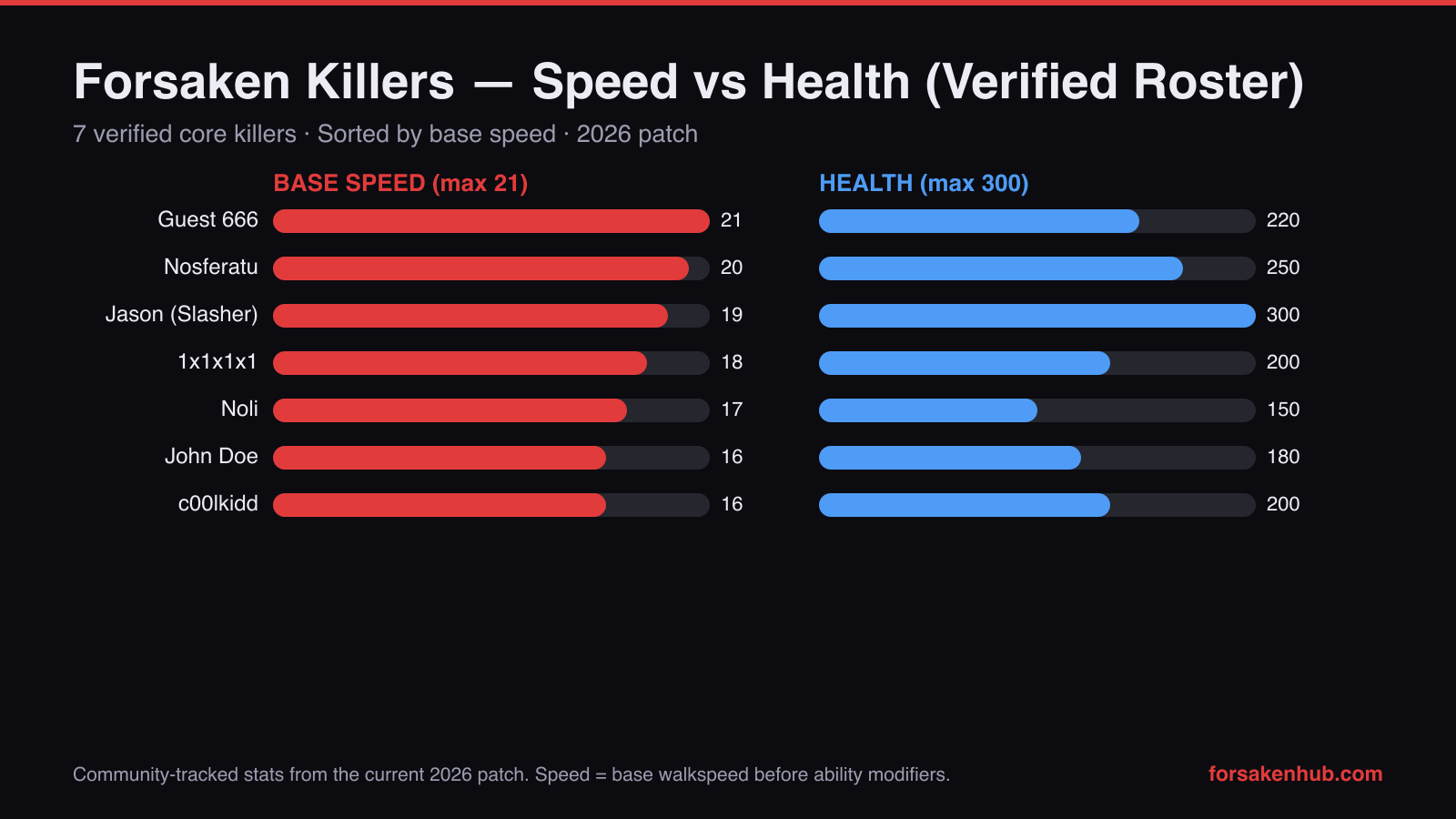
Use this table as your quick reference for every killer in the game. Speed is listed relative to base survivor speed (100%). Health refers to the killer's effective durability against survivor stun tools. The tier ranking reflects the current 2026 meta after all balance patches through February.

KillerSpeedBasic Attack DamageUnlock CostPrimary AbilityTier
1x1x1x1115%281,250 PPMass Infection + Entanglement + Unstable EyeS
Guest 666110%301,500 PPVoid Walk + Shadow Servants + Corrupted VisionS
Nosferatu112%24 (Lacerate)1,922 PPBloodhook + Cataclysm + AscensionS
John Doe115%281,000 PPCorrupt Energy + Digital FootprintA
c00lkidd115%26.5 (Punch)900 PPProjectile + SummonsA
Jason/Slasher115%Varies (Slash 1.9s CD)1,100 PPBehead + Gashing WoundA
Noli115%261,100 PPVoid Rush + Observant + HallucinationsB
Guest 1337110%24 (Hatchet ranged)850 PPHoming Hatchets + Wallhack Vision + MLG ReflexesB
Builderman110%25750 PPBlock Placement + Tool GunB
Peeler118%20500 PPPeel Trap + Slip Stream + Banana BarrageC
Insano108%32600 PPRage Mode + Ground Pound + FrenzyC
The Glitch113%22700 PPTeleport Glitch + Screen Tear + Data CorruptC

1x1x1x1 - The Original Destroyer (S-Tier)

1x1x1x1 is one of Forsaken's most iconic killers and remains firmly in S-tier because he rewards methodical, information-driven play. You do not win by holding W and hoping for hits. You win by stacking crowd control, using reveal tools to confirm positioning, and layering Entanglement to deny escape routes. If you have ever felt like your chases are fine but matches still slip away because generators pop and rescues happen for free, 1x1x1x1 teaches you how to control the entire map. His 1,250 Player Point cost is a mid-range investment that pays off immediately because his kit works at every skill level.

Ability Breakdown

Every 1x1x1x1 tool has a specific job in the pressure loop: reveal, deny, damage, reset.

  • Mass Infection (14s cooldown): Your tempo tool. Applies a pressure state to nearby survivors that accelerates future value from your other abilities. Use it early and often, especially when survivors are still grouped near objectives. It is strongest in the first two minutes of a match when survivors have not split yet. Survivors counter by splitting wide and rotating through cover to avoid follow-up effects.
  • Entanglement (18s cooldown): Stops the clean escape route and forces awkward pathing. Spend it when you can see a committed line (a window or pallet lane) so you deny it on reaction. Never use it blindly or speculatively because the 18-second cooldown is too long to waste. Survivors counter by pre-rotating away earlier or faking direction changes to force blind placement.
  • Unstable Eye (25s cooldown, reveals auras for approximately 7 seconds): Your information tool. Pop it once you are entering a tile so you learn which side the survivor chose, then pick one denial decision: block the route that leads to safety. If the aura shows the survivor already leaving the tile, do not chase stubbornly. Take the free information and rotate to defend the nearest objective instead.
  • Rejuvenate the Rotten (200s cooldown): Long-cooldown power spike that creates chaos. Pop it when the lobby has stabilized (survivors healed and splitting) to re-create pressure. Survivors should slow-play and stall until the window ends rather than giving free snowball downs. Because of the 200-second cooldown, you get this ability once or twice per match, so timing matters enormously.
  • Basic Attack (28 damage): Your consistent damage source. Cash in after Entanglement forces a bad route or after Unstable Eye confirms a corner position. Never swing early for "maybe" hits because 1x1x1x1 wins by setting up guaranteed damage, not gambling on lunges.

Strengths, Weaknesses, and Counterplay

Understanding both sides of the matchup is what separates good 1x1x1x1 players from great ones.

  • Strengths: Information advantage through Unstable Eye means you almost never guess wrong about survivor position. Entanglement removes safe routes from tiles, and Mass Infection creates passive slowdown without requiring regression perks. The combination makes 1x1x1x1 effective on every map and against every team composition.
  • Weaknesses: If you over-commit to a single chase and let three survivors do generators uncontested, your abilities do not help you recover. 1x1x1x1 loses games by "searching" while generators finish. You must constantly decide whether to continue a chase or rotate to defend objectives.
  • Survivor Counterplay: Split wide across the map so Mass Infection cannot hit multiple survivors. Use hard cover to hide from Unstable Eye reveals. Pre-rotate away from tiles before Entanglement can deny your escape route. Against 1x1x1x1, survivors should never group for cooperative generator repairs because that hands him free Mass Infection value.
  • Best Maps: Excels on medium-sized maps like Crossroads and School where Unstable Eye provides actionable information and Entanglement catches survivors in corridors. Struggles slightly on massive open maps like Forest where survivors can split so wide that rotation becomes impossible.
  • Recommended Build: Save the Best for Last, Play With Your Food, Tinkerer, and Discordance. This build combines chase efficiency with generator information, letting you use Unstable Eye for chase decisions and perks for macro decisions.

Guest 666 - The Unstoppable Nightmare (S-Tier)

Guest 666 is the most feared killer in Forsaken and the most commonly banned character in tournament play. His ability to phase through walls with Void Walk fundamentally breaks the loop-based chase system that every other killer must respect. At 1,500 Player Points he is expensive, but the investment is justified by a kill rate that consistently sits above 70% at high ranks. Guest 666 does not play Forsaken the same way other killers do because walls, pallets, and windows simply do not apply to him during Void Walk.

Ability Breakdown

Guest 666's kit creates unavoidable pressure through wall phasing, vision disruption, and AI-controlled map presence.

  • Void Walk (8s cooldown, 3s duration): Phases through all walls and collision for 3 seconds. This ability ignores collision entirely, allowing surprise attacks through floors, ceilings, and solid structures that survivors cannot predict. On indoor maps like Hospital, School, and Haunted Mansion, Void Walk creates situations where there is literally no counterplay because the killer approaches from directions that should be physically impossible.
  • Corrupted Vision (passive, pulses every 4 seconds): All survivors within 24 meters suffer intermittent blindness lasting 0.5 seconds per pulse. This disrupts looping precision because survivors lose visual tracking at critical vault and pallet moments, causing mistimed plays. The effect is constant and cannot be cleansed or avoided except by staying more than 24 meters away.
  • Shadow Servants (45s cooldown, spawns 2 AI shadows): Two AI-controlled shadows patrol generators and reveal survivor auras when within 8 meters. These servants force survivors off generators even when Guest 666 pressures elsewhere, creating artificial three-gen situations. Shadow Servants effectively give Guest 666 map presence in three locations simultaneously.
  • Basic Attack (30 damage): The highest base damage of any killer in the game. Combined with Corrupted Vision making survivors miss vault timings, Guest 666 downs survivors faster than any other killer in raw chase scenarios. Two clean hits from full health downs a survivor, which is standard, but 30 damage means fewer total swings needed when combined with ability chip damage.

Strengths, Weaknesses, and Counterplay

Guest 666 has the smallest counterplay window of any killer in the game, which is exactly why he dominates.

  • Strengths: Void Walk removes the entire pallet and window system from the game during its 3-second duration. Shadow Servants provide free map pressure and information. Corrupted Vision disrupts survivor mechanics passively. The combination means Guest 666 has no bad maps and no bad matchups.
  • Weaknesses: Void Walk has a brief 8-second cooldown window where Guest 666 must respect pallets and windows normally. Coordinated teams that split across the map can force Guest 666 into long rotations where Shadow Servants alone cannot secure kills. His 110% speed is below average for killers, meaning he relies on abilities rather than raw speed.
  • Survivor Counterplay: Sprint Burst and Dead Hard are mandatory against Guest 666 because they provide distance during Void Walk that positioning alone cannot. Stay more than 24 meters away to avoid Corrupted Vision pulses. Spread across the map so Shadow Servants can only threaten one survivor at a time. Never group for cooperative repairs against Guest 666.
  • Best Maps: Guest 666 excels on indoor maps like Hospital, School, and Haunted Mansion where Void Walk creates unavoidable situations in narrow corridors. Even on survivor-favored open maps, Guest 666 maintains 65%+ kill rates through raw ability strength.
  • Tournament Ban Rate: Guest 666 is banned in 67% of competitive matches. If you are playing competitive Forsaken, learning Guest 666 is mandatory even if you never play him, because understanding his kit from the killer side teaches you how to survive against him.

Nosferatu - The Aerial Predator (S-Tier)

Nosferatu is Forsaken's most expensive killer at 1,922 Player Points and one of the most dangerous when you chain his mobility tools correctly. He is not a one-gimmick killer. He has stealth through silent footsteps via Levitation, burst mobility with Cataclysm dash, ranged disruption through Hunter's Feast orb, a long-range catch tool in Bloodhook, and a vertical threat with Ascension flight. That kit means survivors cannot counter you with one habit like "just loop pallets" or "just hold W." For a deeper dive into his combos, visit the /forsaken-killers page where we have a dedicated Nosferatu guide.

Ability Breakdown

Nosferatu cycles five different tools, making him the most mechanically demanding killer in Forsaken.

  • Levitation (passive): Removes footstep sounds entirely. Your best free hits come from approaching on angles where survivors rely on audio cues: corners, stair tops, and doorframes. This passive makes Nosferatu's approach fundamentally different from every other killer because survivors cannot hear you coming.
  • Lacerate / M1 (2s cooldown, 24 damage, 0.3s windup, 7.5-stud range): Your consistent damage source. Cash in after Cataclysm or Bloodhook forces a bad path. Because the base hit is not huge burst damage, your goal is to use cooldowns to create hit windows, then use Lacerate to collect the damage safely.
  • Bloodhook (20s miss / 30s hit cooldown, approximately 115-stud range, up to 35 total damage on hit): Long-range chain that pulls survivors toward you. Use it as a start-of-chase catch tool and mid-lane punish when survivors over-run in the open. Survivors counter by hiding behind micro-cover and hard-turning corners to break the chain line.
  • Cataclysm (25s cooldown): Invisibility dash plus 10 damage explosion plus puddles that apply Bleeding II and Slowness II lasting 12 seconds. Puddles highlight survivors for 5 seconds. Use it to break strong loops and zone off mandatory travel lines so survivors must reroute through weaker areas.
  • Hunter's Feast (20s cooldown): Orb that deals 5 damage, applies Oblivious and Creatures for 10 seconds, and grants stealth buffs on hit. Force movement with the orb and use the stealth window to cut off the next objective instead of immediately swinging.
  • Ascension (35s cooldown): Temporary flight that changes your approach angle and lets you reposition. Use for endgame interception, scouting rotations, and breaking safe corner patterns. Survivors counter by rotating wide and stalling until the flight window ends.

Practical Combo Routes

Nosferatu wins by chaining tools into each other, not by pressing one button and hoping.

  • Chase Opener Combo: Bloodhook from range to pull survivor in, then immediate Lacerate for guaranteed damage. This combo deals up to 59 total damage (35 Bloodhook + 24 Lacerate) from a single approach sequence.
  • Loop Breaker Combo: Cataclysm through the strong tile to create puddles, then Lacerate as survivor reroutes through weak space. The puddle slowness makes the follow-up hit nearly guaranteed if placed correctly.
  • Information Into Ambush: Hunter's Feast to reveal survivor position, then Levitation (silent approach) into Lacerate from an angle the survivor is not watching. This combo works best on indoor maps with many corners.
  • Endgame Closer: Ascension to fly over exit gate area, identify which gate survivors are opening, then drop down with Bloodhook to pull them away from the switch. This sequence catches survivors who thought they were safe at 99% gate progress.
  • Weakness: If you waste Bloodhook early and miss, you have a 20-second window with no catch tool. Skilled survivors recognize when Nosferatu has used his cooldowns and pressure aggressively during those windows. Manage your cooldown economy carefully.

Pro Tip

The three S-tier killers (1x1x1x1, Guest 666, Nosferatu) share one thing in common: they all have information tools that remove guessing from chase decisions. If you want to climb ranks fast, pick one S-tier killer and master it before branching out. 1x1x1x1 is the best starting choice because his abilities are forgiving and his learning curve is moderate. Guest 666 is the strongest but may get nerfed. Nosferatu has the highest skill ceiling and the most rewarding gameplay once mastered. For detailed build guides and perk loadouts, visit the /forsaken-killers page.

John Doe - The Setup Specialist (A-Tier)

John Doe is a setup-to-snowball killer. Your best games come from early map control through traps and space denial that converts into fast downs once survivors start panicking. A lot of players try to run John Doe like a pure chase killer, then wonder why their pressure feels inconsistent. The truth is simple: John Doe is at his strongest when you spend the first minute building a trap network and forcing survivors into predictable lanes. At 1,000 Player Points he is a solid mid-range investment.

Ability Breakdown and Strategy

John Doe has fewer flashy buttons than Nosferatu, but each tool is high leverage if treated like a map-control kit.

  • Corrupt Energy (approximately 18s cooldown): Spawns a spike wall to deny lanes and force pathing. Place it to cut the safe line to a window or pallet so the survivor must turn early into your attack range. Never place it reactively at random; spend it when the survivor is committed to a lane and cannot reverse direction.
  • Digital Footprint (max 3 active): Trap and mark tool that punishes predictable routes. Cover rescue approaches, common hallway corners, and the return line after survivors split from generators. Place two traps before your first real chase because two early traps are worth more than one early hit since they keep paying you back all match.
  • Basic Attack (28 damage): Swing only when you have already forced a bad route with walls or traps. John Doe's M1 is the same as most killers, so your advantage comes entirely from ability setup, not from raw chase mechanics.
  • First 90 Seconds Game Plan: Place two Digital Footprints on common rotation lanes before taking your first chase. Then choose a chase that leads back into your trap triangle. This setup-first approach consistently outperforms the "sprint at first survivor you see" approach by 15-20% kill rate improvement.
  • Counterplay: Survivors counter John Doe by slow-walking around corners to spot traps, by pressuring generators aggressively in the first minute before his trap network is established, and by double-backing through cleared areas rather than taking new paths.

c00lkidd (coolkid) - The Lane Controller (A-Tier)

c00lkidd is a pressure-and-disruption killer. You do not win by one-shot power; you win by layering slows, reveals, and chaos until survivors cannot rotate cleanly. A lot of c00lkidd games feel either amazing or terrible depending on whether you are controlling lanes or getting dragged into long loops. The difference is not "aim better" but choosing when to spend your projectile pressure, where to force survivors to move, and how to convert aura reveals into real downs. At 900 Player Points he is one of the most accessible A-tier killers.

Ability Breakdown and Strategy

c00lkidd is strongest when you stop chasing "the survivor" and start chasing "the lane." You win by owning space.

  • Punch / M1 (26.5 damage): Your baseline damage and chase finisher. Cash in after your projectile creates slow and reveal so the survivor cannot juke as cleanly. The 26.5 damage is slightly below average, which means you need to set up your hits rather than trading blows.
  • Projectile (15 damage + Slowness approximately 4 seconds + Aura reveal approximately 10 seconds): Your most important tool. Fire to force a turn: if they dodge, they still lose their lane; if it hits, you track them for 10 full seconds and close the gap during the 4-second slow window. The 10-second aura reveal is exceptionally long and should always change your pathing decision.
  • Summons / Bots (varies by patch): Creates chaos, pressure, and forces survivor movement. Use to dislodge survivors from safe setups and to make rescues messy. Survivors counter by splitting wide and avoiding grouping where summons gain maximum value.
  • Lane Control Philosophy: Take the first chase near objectives, not the one that drags you to the map edge. Use your projectile early if it forces a bad rotate because you are buying map tempo, not just damage. If you hit with the projectile and see the aura, choose a cutoff route instead of following scratch marks.
  • Endgame Strength: c00lkidd excels in endgame because survivors must travel through predictable lanes to reach exit gates. Fire projectiles down gate corridors to reveal and slow runners, then cut them off. c00lkidd converts more endgame kills than almost any other A-tier killer.

Jason / Slasher - The Tempo Killer (A-Tier)

Jason (the Slasher redesign from Update 3.1.0, August 2025) is a tempo killer. Your cooldown timings create the match rhythm, and good Slashers win by forcing survivors into no-win choices at tiles. Slasher is a classic Forsaken pick because he is straightforward but not simple. Your abilities are easy to understand and hard to time. If you are missing Behead, wasting Gashing Wound, or getting looped because you swing on autopilot, the fix is patience, not mechanics. At 1,100 Player Points he sits at a fair price for his consistent A-tier performance.

Ability Breakdown and Strategy

Slasher improves fast when you stop improvising and start repeating patterns.

  • Slash / M1 (1.9s cooldown): Fast baseline attack with short recovery. Use after you force a bad turn or after a commitment. Do not swing early for "maybe" hits because Slasher rewards discipline. The 1.9s cooldown is faster than most killers, giving you quicker recovery between swings.
  • Behead (18.5s cooldown): High-impact punish tool. Use when the survivor is locked into a vault or a long lane. Treat it like a "commitment tax": wait for one committed action (a vault, a long lane, or a forced straight run) and punish at the moment the survivor cannot hard-turn behind cover. If the survivor fakes the vault, you still win because you forced hesitation and gained distance.
  • Gashing Wound (32s cooldown): Pressure tool that punishes greedy pathing. Use to break strong tiles or force survivors to leave a safe loop into weak space. Identify the tile that keeps resetting the chase and use Gashing Wound to deny the clean loop, then herd them into weak space before spending Behead.
  • Pattern: Hold, Commit, Punish: Walk the loop normally for a few seconds so the survivor reveals their preferred route. Wait for one committed action. Use Behead at the moment they cannot escape. Take the reliable hit and do not go for a greedy second mindgame. This repeatable pattern works in most lobbies.
  • Friday the 13th Variant: Jason receives special buffs when playing on Friday the 13th dates, according to community reports. These include reduced cooldowns and increased damage. Check the calendar and take advantage of these date-specific buffs when available.
  • Counterplay: Survivors counter Slasher by faking vaults to waste Behead, by pre-rotating out of tiles before Gashing Wound can deny their safe loop, and by refusing to commit to straight lines where Behead connects.

A-tier killers (John Doe, c00lkidd, and Jason/Slasher) are all strong enough to consistently 3K or 4K in public matches, but they have exploitable weaknesses that coordinated SWF teams can abuse. If you are losing consistently with an A-tier killer, the problem is almost always "wrong tool timing" or "wrong lane choice," not mechanical skill. Review your matches and ask: "Did I use my ability because it was off cooldown, or because the situation called for it?" That distinction separates A-tier killers who feel S-tier from ones who feel B-tier.

Noli - The Mindgame Killer (B-Tier)

Noli is a mindgame killer added in July 2025 (Update 3.0.0). You do not win by raw speed; you win by making survivors play wrong because they cannot trust what they see. If you like killers that feel smart (baiting rotates, denying information, forcing survivors into bad choices), Noli is one of the most rewarding picks in Forsaken. At 1,100 Player Points he costs as much as some A-tier killers, but his B-tier ranking reflects the fact that his kit requires survivors to make mistakes rather than forcing mistakes the way S-tier killers do.

Ability Breakdown and Strategy

Noli feels weak if you press buttons because they are available. He feels oppressive when each tool has a job: find, threaten, convert.

  • Void Rush (20s cooldown): Engage tool that closes distance and forces panic. Use as a commitment punish when survivors over-run a lane or hesitate at a corner. Survivors counter with hard turns behind cover and pre-rotations so the rush does not connect cleanly.
  • Observant (30s cooldown): Information tool and decision maker. Pop it before you choose a chase direction so you stop guessing which side is busy. Use it early so you do not waste 30 seconds searching the wrong side of the map.
  • Hallucination System (passive, meter-based): Misinformation mechanic that makes survivors doubt their reads. Build hallucination pressure early through short chases, then use it to force wrong rotations and punish indecision. Your first goal is hallucination value, not downs, because once survivors start doubting their reads, every subsequent chase becomes easier.
  • Weakness: Noli struggles against survivors who play disciplined, slow, and hold W without engaging in mindgames. If a survivor refuses to react to hallucinations and simply runs in a straight line, Noli has limited tools to force the issue. He needs survivors to engage with his tricks to gain value.
  • Map Preference: Noli excels on maps with many corners and rooms like Haunted Mansion, Hospital, and Castle where hallucinations create genuine confusion. He struggles on open maps like Crossroads and Forest where survivors can visually confirm what is real from a distance.

Guest 1337 - The Ranged Specialist (B-Tier)

Guest 1337 brings precision and skill expression to killer gameplay with homing hatchets, post-hook aura reading, and pallet-immune attacks. At 850 Player Points he is affordable and rewards mechanical skill more than any other killer in the game. Guest 1337 has the highest skill ceiling among B-tier killers: professional players land 73% of hatchet throws compared to the average player's 41%, which means the same killer can feel anywhere from C-tier to A-tier depending on your aim. For more on survivor matchups against Guest 1337, check the /forsaken-survivors page.

Ability Breakdown and Strategy

Guest 1337 rewards pure mechanical skill more than game sense, which is both his strength and his limitation.

  • Homing Hatchets (ranged, 1.5s wind-up, slight curve toward survivors within 2 meters of trajectory): Throws hatchets that curve slightly toward survivors, rewarding good aim while forgiving minor misses. The 1.5-second wind-up creates mindgame potential at loops because survivors must decide whether to vault or dodge before the throw.
  • Wallhack Vision (triggers after hooking, 8s duration, map-wide): After hooking a survivor, Guest 1337 sees all survivor outlines through walls for 8 seconds regardless of distance. This reveals generator progress and healing positions for strategic target selection. Smart Guest 1337 players hook first, then use the 8-second window to plan their next rotation.
  • MLG Reflexes (passive): Guest 1337 cannot be stunned by pallets when holding a hatchet, instead destroying the pallet instantly while maintaining movement. This deletes safe pallets from the map, and over time, the map becomes more and more dangerous for survivors as resources disappear.
  • Hatchets Have No Maximum Range: Skilled players memorize arc trajectories for specific tiles, guaranteeing hits at common loops. Cross-map shots that interrupt actions from unexpected angles are possible and devastating.
  • Counterplay: Unpredictable movement and breaking line of sight counter hatchets. Save pallets for actual stuns during hatchet reload windows when MLG Reflexes is not active. Against Guest 1337, the best survivor strategy is constant unpredictable movement rather than committing to standard loop patterns.

Builderman - The Constructor (B-Tier)

Builderman is one of the most unique killers in Forsaken because he literally reshapes the map during the match. Through permanent block placement and temporary Tool Gun walls, Builderman transforms safe survivor tiles into dead zones and blocks infinite loops. At 750 Player Points he is affordable, but his B-tier ranking reflects a steep 20+ hour learning curve for optimal block placements per map. Builderman rewards patience and map knowledge over raw chase skill.

Ability Breakdown and Strategy

Builderman creates the map you want to play on rather than accepting what the game gives you.

  • Block Placement (max 10 permanent blocks per match, 2 seconds each to place): Places permanent blocks that reshape loops and create new tiles. Strategic placement transforms unsafe areas into dead zones while blocking infinite loops. Poor placement actively helps survivors by creating new loops, so learning correct positions is critical.
  • Tool Gun (8s cooldown, creates 5-second temporary walls): Secondary ability spawns temporary walls for mindgames at tiles. Skilled Builderman players block vault windows mid-chase to create unreactable situations. The 8-second cooldown allows frequent usage throughout every chase.
  • Setup Phase: Builderman requires the first 60-90 seconds for block placement. Corrupt Intervention as a perk provides this setup time. Without setup, Builderman is a basic M1 killer with 110% speed and 25 damage, which is below average.
  • Map-Specific Strength: Builderman maintains 52% kill rate overall but jumps to 64% on maps with strong main buildings that blocks can neutralize. He excels on Asylum, Hospital, and Castle where blocking key windows and corridors removes survivor safety. He struggles on open maps like Forest and Crossroads.
  • Counterplay: Observant survivors memorize block placements and adapt routing. Aggressive early game pressure prevents Builderman from establishing setup. Teams that deny the setup phase through fast generator completion in the first 90 seconds usually escape. Check our /forsaken-maps page for specific block placement counters per map.

C-Tier Killers - Peeler, Insano, and The Glitch

C-tier killers have interesting concepts but insufficient power to compete consistently against skilled survivors. These killers can still win public lobby matches, and they all have unique gimmicks that catch unprepared teams off guard, but in coordinated play their weaknesses become too exploitable. If you enjoy challenge runs, meme builds, or just want to surprise opponents who have never seen these killers, C-tier has its niche. Each of these killers costs under 750 Player Points, making them accessible to newer players who want to experiment.

Peeler - The Slip King (C-Tier)

Peeler is the fastest killer in the game at 118% speed but deals the lowest base damage at only 20 per hit. His kit revolves around banana-themed traps and area denial that force survivors into awkward pathing.

  • Peel Trap (max 5 active, no cooldown between placements): Places banana peel traps on the ground that cause survivors to slip, losing control for 1.5 seconds and taking 10 damage. The slip animation locks survivors in place, giving Peeler time to close distance for a basic attack. Traps are visible but small, making them easy to miss during panicked chases.
  • Slip Stream (25s cooldown): Peeler slides forward at 200% speed for 2 seconds, leaving a trail of banana residue that slows survivors who step on it by 30% for 3 seconds. Use Slip Stream to close distance or to create slow zones in front of exit gates and generators.
  • Banana Barrage (40s cooldown): Throws a spread of 5 banana peels in a fan pattern covering a wide area. Useful for area denial during generator clusters and exit gate openings. The spread pattern makes dodging difficult in tight corridors.
  • Why C-Tier: Peeler's 20 damage per hit means he needs 5 clean hits to down a full-health survivor, which is the worst damage efficiency in the game. His speed compensates partially, but skilled survivors who watch the ground and avoid traps reduce him to a fast M1 killer with weak attacks. Peel traps are also easily destroyed by survivors who crouch-walk over them.
  • Where Peeler Works: Underground War and tight corridor maps where traps are harder to spot and Slip Stream covers hallway width entirely. In public lobbies with inexperienced survivors, Peeler's trap-based chaos can snowball matches effectively.

Insano - The Berserker (C-Tier)

Insano deals the highest base damage of any killer at 32 per hit but moves at only 108% speed, the slowest in the game. His kit revolves around explosive, high-commitment attacks that either devastate or completely whiff.

  • Rage Mode (45s cooldown, 8s duration): Insano enters a berserker state gaining 125% speed and 40 damage per hit for 8 seconds. During Rage Mode, Insano also destroys pallets on contact without any animation, simply running through them. The 45-second cooldown means you get Rage Mode roughly twice per chase cycle.
  • Ground Pound (30s cooldown, 12-stud radius): Slams the ground dealing 15 damage to all survivors within 12 studs and applying a 3-second stagger that prevents vaulting and pallet interactions. Ground Pound is excellent for breaking grouped survivors and preventing vault plays during chase.
  • Frenzy (passive, builds over time): As the match progresses, Insano gains 1% permanent speed every 60 seconds, capping at 10% additional speed by the 10-minute mark. This passive rewards long games and punishes survivors who cannot finish generators quickly.
  • Why C-Tier: Insano's 108% base speed means survivors can hold W and create distance without using any resources. His power budget is entirely loaded into Rage Mode's 8-second window, and if survivors simply hide during those 8 seconds, they waste his entire ability. The 45-second cooldown between Rage Mode activations creates long windows where Insano is the weakest killer in the game.
  • Where Insano Works: Small maps like Underground War and Glass Houses where his slow base speed matters less because survivors cannot run far. Late-game situations where Frenzy stacks have accumulated and generators are clustered, making Rage Mode devastating for defending the final three generators.

The Glitch - The Digital Disruptor (C-Tier)

The Glitch manipulates the game environment itself, disrupting survivor UI, teleporting unpredictably, and corrupting survivor controls. At 700 Player Points he is the most expensive C-tier killer, and his kit is the most disorienting to play against.

  • Teleport Glitch (15s cooldown): Instantly teleports to a random location within 40 studs. The randomness is both The Glitch's strength and weakness: sometimes you teleport directly behind a survivor for a free hit, and sometimes you teleport into a wall facing the wrong direction. You cannot control the exact destination, only the approximate range.
  • Screen Tear (35s cooldown, 6s duration): Causes all survivors within 30 studs to experience visual distortion (screen tearing, color inversion, and UI flickering) for 6 seconds. During Screen Tear, survivors cannot read skill check prompts and generators regress at 150% speed. The disorientation effect makes chases easier because survivors misjudge distances.
  • Data Corrupt (50s cooldown): Corrupts one targeted survivor's controls for 4 seconds, randomizing their movement inputs (pressing left might move them right, forward might move them backward). Data Corrupt is devastating when it connects but has a 3-second charge-up animation that experienced survivors recognize and dodge.
  • Why C-Tier: The Glitch's randomness works against him as often as it works for him. Teleport Glitch wastes time when it sends you to bad positions, Screen Tear requires being within 30 studs which a 113% speed killer struggles to maintain, and Data Corrupt's 3-second charge-up telegraphs the attack. Against coordinated teams who understand his tells, The Glitch becomes predictable despite being "random."
  • Where The Glitch Works: The Glitch excels against new players who do not understand his visual disruption effects and panic during Screen Tear. On maps with many tight corridors like Hospital and Happy Home, Teleport Glitch has a higher chance of appearing in useful positions because the 40-stud range covers more meaningful space.

Complete Killer Tier Ranking (2026 Meta)

This tier list reflects the current 2026 meta after all balance patches. Rankings consider kill rate at high ranks, tournament performance, counterplay difficulty, and consistency across different maps and team compositions.

TierKillerAvg Kill RateBest MapHardest Counter
S1x1x1x170%SchoolCoordinated splitting + hard cover
SGuest 66673%HospitalSprint Burst + 24m+ spacing
SNosferatu68%CastleCorner cutting + cooldown tracking
AJohn Doe59%Haunted MansionEarly aggression before trap setup
Ac00lkidd58%CrossroadsLine-of-sight breaking after projectile
AJason/Slasher57%Happy HomeFake vaults + pre-rotation
BNoli53%Haunted MansionDisciplined W-key holding
BGuest 133751%CrossroadsUnpredictable movement patterns
BBuilderman52%AsylumDeny setup in first 90 seconds
CPeeler44%Underground WarWatch ground + crouch-walk traps
CInsano42%Glass HousesHold W during Rage Mode
CThe Glitch43%HospitalLearn visual tells + stay 30m+ away

Pro Tip

When choosing which killer to invest Player Points in, consider your playstyle first. If you prefer methodical, information-based gameplay, 1x1x1x1 and John Doe reward planning. If you want aggressive, mechanical gameplay, Nosferatu and Guest 1337 reward aim and combo execution. If you enjoy chaos and disruption, c00lkidd and Noli create the most confusion for survivors. Do not buy a killer just because it is S-tier if the playstyle does not match your strengths. A player who masters an A-tier killer they enjoy will consistently outperform a player who half-learns an S-tier killer they find boring. Browse the full roster on our /forsaken-killers page to see gameplay footage before investing.

How Killer Choice Interacts With Maps

Killer tier rankings shift dramatically based on map selection. Understanding which maps amplify your killer's strengths and which maps expose their weaknesses is just as important as mastering abilities. For detailed map breakdowns, visit our /forsaken-maps page.

Map Size and Killer Speed

The relationship between map size and killer speed determines whether you can maintain pressure across the entire map or must concede areas.

  • Small Maps (Glass Houses, Underground War, Make a Cake): Slow killers like Insano (108% speed) perform significantly better because survivors cannot create meaningful distance. Fast killers like Peeler (118%) gain less value from their speed advantage because there is nowhere for survivors to run that is far from killer patrol routes.
  • Medium Maps (Crossroads, School, Happy Home, Asylum): Balanced for most killers. This is where tier rankings are most accurate because neither map size nor layout creates extreme advantages. Medium maps test killer ability usage and game sense rather than raw speed.
  • Large Maps (Forest, The Tempest, Planet Voss, SFOTH): Mobility killers and killers with map-wide abilities dominate. Nosferatu's Ascension and Bloodhook cover massive distances. Guest 666's Shadow Servants provide remote pressure. Killers without mobility tools (Builderman, Insano, Peeler) struggle to maintain pressure across large maps.
  • Indoor Maps (Hospital, Haunted Mansion, Horror Hotel): Favor killers with anti-loop or wall-ignoring abilities. Guest 666's Void Walk becomes nearly impossible to counter in tight corridors. Noli's hallucinations are more convincing in rooms with limited sightlines. Ranged killers like Guest 1337 struggle because long throwing lanes are rare.
  • For specific map strategies with each killer, visit /forsaken-maps for our complete map guide collection covering all 21 maps currently in the game.

Picking Your First Killer: Investment Guide

Not every player should start with the most expensive S-tier killer. Your first killer purchase should match your experience level, available Player Points, and preferred learning path. Here is a structured recommendation based on where you are in your Forsaken journey.

By Experience Level

Match your killer investment to your current skill level for the fastest improvement.

  • Brand New Players (0-20 hours): Start with Peeler (500 PP) or Insano (600 PP). Yes, they are C-tier, but their simple kits let you focus on learning map layouts, chase fundamentals, and generator patrol patterns without ability management complexity. Graduate to A-tier after 20 matches.
  • Intermediate Players (20-100 hours): Invest in c00lkidd (900 PP) or John Doe (1,000 PP). These A-tier killers reward the game sense you have developed while being forgiving enough that ability misuse does not lose you the match. Both killers teach transferable skills that apply to every other killer.
  • Advanced Players (100+ hours): Save for 1x1x1x1 (1,250 PP) or Nosferatu (1,922 PP). These S-tier killers have the mechanical depth and strategic complexity to reward thousands of hours of play. If you have strong aim, Nosferatu's Bloodhook combos will carry you. If you prefer strategy, 1x1x1x1's information loop is unmatched.
  • Completionists: Guest 666 (1,500 PP) is a worthwhile investment for understanding the strongest killer in the game from the inside, which also teaches you how to counter him when you play survivor. Guest 1337 (850 PP) and Builderman (750 PP) offer unique gameplay that no other killer replicates.
  • Budget Option: If Player Points are limited, c00lkidd at 900 PP offers the best value-to-tier ratio in the game. He is A-tier, costs less than every S-tier and most B-tier options, and his projectile+summon kit works at every skill level. If you want to show off Forsaken merch while grinding, check our /merch page for exclusive fan gear.

Final Thoughts

Forsaken's 12-killer roster in 2026 offers genuine variety in playstyle, complexity, and power level. The S-tier trio of 1x1x1x1, Guest 666, and Nosferatu dominate high-rank play through information, wall-phasing, and aerial mobility respectively. The A-tier killers John Doe, c00lkidd, and Jason/Slasher provide consistent results that reward smart ability usage. B-tier Noli, Guest 1337, and Builderman offer unique gameplay fantasies for players who value creativity over raw power. And C-tier Peeler, Insano, and The Glitch serve as accessible entry points and fun challenge picks. Regardless of which killer you choose, the single most important skill is knowing when to use your abilities versus when to save them. Every killer in this list becomes dramatically more effective when you stop pressing buttons because they are off cooldown and start pressing them because the situation demands it.

  • S-tier killers (1x1x1x1, Guest 666, Nosferatu) share a common trait: information tools that remove guessing from chase decisions, maintaining 68-73% kill rates
  • A-tier killers (John Doe, c00lkidd, Jason/Slasher) reward setup, lane control, and patience with consistent 57-59% kill rates against all but the most coordinated teams
  • B-tier killers (Noli, Guest 1337, Builderman) offer unique gameplay mechanics with 51-53% kill rates that climb higher on specific maps and against unprepared opponents
  • C-tier killers (Peeler, Insano, The Glitch) are accessible and fun but struggle against experienced survivors, maintaining 42-44% kill rates in competitive play
  • Map selection dramatically shifts killer effectiveness: indoor maps favor anti-loop killers, open maps favor mobility, and small maps equalize speed differences
  • Your first killer purchase should match your experience level, not the tier list; mastering a comfortable A-tier killer beats half-learning an uncomfortable S-tier one
  • Visit /forsaken-killers for detailed individual guides, /forsaken-maps for map-specific strategies, and /forsaken-survivors to understand the other side of every matchup

Pick one killer from this guide that matches your playstyle and commit to 20 matches before switching. Track your kill rate per match to measure improvement objectively. Once you are consistently achieving 3K+ results, expand to a second killer that covers your first killer's weak maps. Join the Forsaken community to discuss killer strategies, and visit our /merch page for exclusive Forsaken gear to represent your main!

Share: