Work at a Pizza Place Map Guide - Forsaken Roblox (2026)
Complete guide to the Work at a Pizza Place map in Forsaken. Learn kitchen loops, dining area strategies, and delivery route escapes.
Work at Pizza Place brings one of Roblox's most beloved game environments into Forsaken transforming the familiar pizza restaurant, delivery routes, and neighborhood into a horror-survival battleground where nostalgia meets nightmares. This map adapts the iconic Pizza Place layout that millions of Roblox players know from the original Work at a Pizza Place game, complete with the restaurant kitchen, dining area, manager's office, delivery vehicles, and surrounding residential neighborhood. The adaptation preserves recognizable landmarks while redesigning the space for Forsaken's asymmetric gameplay, creating a mixed indoor-outdoor environment where the restaurant serves as a central stronghold, delivery streets provide transit corridors, and nearby houses offer secondary loop structures. What makes this map special beyond nostalgia is its hybrid layout: the restaurant interior plays like a tight indoor map similar to Reborn Family Abode, while the surrounding streets and houses create open outdoor gameplay reminiscent of SFOTH. Survivors who understand this dual nature and seamlessly transition between indoor restaurant play and outdoor street play achieve 54-58% escape rates compared to 40% for survivors who commit entirely to one environment. This guide covers every kitchen counter, every delivery route, and every neighborhood house needed to master Forsaken's most nostalgic map. For the complete Forsaken map lineup, visit /forsaken-maps.
Quick Stats: Work at Pizza Place
- • Map Size: Medium (9,000 sq studs)
- • Difficulty: Intermediate
- • Generators: 7 spawns, 5 required
- • Cover spots: 11-13 spawns
- • Key Structures: Restaurant + 4 houses + streets
- • Indoor/Outdoor Split: 40%/60%
- • Best For: Hybrid indoor-outdoor transition play
- • Killer Win Rate: 48% (slightly survivor-favored)
Pizza Place Map Layout and Key Areas
The map centers on the Pizza Place restaurant positioned in the middle of a small neighborhood with residential streets radiating outward. The restaurant is the largest and most complex structure, containing the kitchen, dining room, manager's office, and supply room. Surrounding streets connect to four residential houses of varying sizes, a small park, and the delivery parking area. Two escape window spawn at opposite ends of the street network. The layout creates natural gameplay zones: the restaurant interior for tight loops and stealth play, the streets for transit and vehicle loops, and the houses for secondary shelter and generator completion.
1 - The Pizza Place Restaurant
The central and most important structure on the map:
- •Kitchen: The heart of the restaurant featuring a center prep counter, pizza ovens, a walk-in freezer, and ingredient shelving. The prep counter creates the map's strongest indoor loop (15-20 second rotations) with the pizza ovens forcing killers into wider pathing around the hot equipment. The walk-in freezer has a heavy door that closes behind you creating a 2-second delay for pursuing killers, making it a powerful mid-chase obstacle. Contains a guaranteed generator spawn near the oven area and a cover spot between the counter and freezer door.
- •Dining Room: The front-of-house area with 6-8 tables, chairs, a counter with cash register, and large front windows providing outdoor visibility. The dining tables create a cluttered zone with multiple minor obstacles (5-8 seconds per table) that chain into 20-30 second sequences when survivors weave between tables. The front windows allow survivors to monitor street activity and killer approach from outdoors. The cash register counter provides a small loop (8-10 seconds). Contains a generator spawn 40% of the time near the window tables.
- •Manager's Office: A small room off the kitchen containing a desk, filing cabinet, and safe. The desk provides a weak loop (6-8 seconds) but the room's single entrance makes it a risky dead end. The office has a window to the back alley providing an emergency vault escape. Contains a generator spawn 30% of the time. The filing cabinet can be crouched behind for stealth when the killer searches the kitchen.
- •Supply Room: Located behind the kitchen, the supply room contains flour bags, sauce cans, and pizza boxes stacked on shelving units. The shelving creates narrow gaps providing line-of-sight breaks and minor movement advantage for survivors. A back door connects the supply room to the alley behind the restaurant. Contains a cover spot at the back door and a locker for emergency hiding.
- •Restroom: A small dead-end room accessible from the dining room hallway. Contains a locker but no loop structures or exits. Avoid during chases entirely. Only useful for pre-chase hiding when the killer has not detected you.
2 - Streets and Delivery Area
The street network connecting all structures:
- •Main Street: A 10-stud-wide road running past the restaurant front door toward the residential area. The street is lined with sidewalks, lampposts, and occasional mailboxes providing minimal cover. Main street is moderately dangerous during transit but less exposed than open maps because the surrounding houses and restaurant create ambient cover that prevents extreme long-range sightlines.
- •Delivery Parking Lot: A small paved area beside the restaurant with 2 delivery vehicles (pizza cars) providing standard vehicle loops (15-20 seconds each). The delivery lot connects to the main street and the alley. Contains a generator spawn 50% of the time near the parking spaces. The delivery vehicles are among the safest outdoor loop structures on the map.
- •Back Alley: A narrow corridor (6 studs wide) running behind the restaurant and connecting to the side street. The alley contains dumpsters and trash cans providing minor obstacles. The narrow width makes the alley dangerous for extended chases but useful for quick stealth transitions between the restaurant back door and the side streets.
- •Side Street: A secondary road running perpendicular to main street connecting two residential houses. The side street is narrower (8 studs) with parked cars providing occasional cover. Contains a cover spot at the street corner intersection.
- •Intersection: The main street and side street meet at a T-intersection near the restaurant. The intersection features a stop sign and street light that provide zero gameplay cover but serve as a landmark for navigation. The intersection is the most exposed outdoor position on the map.
- •Street Transit Safety: When moving between the restaurant and houses, use the sidewalks against building walls rather than walking in the center of streets. Building wall proximity provides partial cover from cross-street sightlines and faster access to building interiors when the killer appears.
3 - Residential Houses
Four neighborhood houses provide secondary structures and generator locations:
- •Corner House (Large): A two-story house northwest of the restaurant with a living room, kitchen, and upstairs bedroom. The living room sofa creates a medium loop (10-12 seconds) and the upstairs bedroom window provides a vault escape to the front yard. Contains a generator spawn 60% of the time and a guaranteed cover spot on the first floor. This is the best residential structure on the map.
- •Across-Street House (Medium): A single-story house east of the restaurant with a living room and bedroom connected by a hallway. Contains a bed loop (8-10 seconds) and a window vault to the backyard. Contains a generator spawn 40% of the time and a cover spot in the hallway.
- •Side Street House (Small): A compact house south of the restaurant with a single open room containing a couch and TV. The couch provides a weak loop (6-8 seconds) with a front door and back door preventing dead-end scenarios. Contains a generator spawn 30% of the time.
- •Far House (Medium): The most distant structure from the restaurant, positioned at the map's northwest edge. Contains a kitchen-living room combo with an island counter loop (10-12 seconds) and a cover spot at the front door. Contains a generator spawn 50% of the time. Its distance from the restaurant makes it the safest early-game repair location.
- •House Yard Areas: Each house has a small yard with fences, bushes, or lawn decorations providing minor outdoor cover. Yard fences create short chase obstacles (3-5 seconds per fence corner) that supplement house interior loops when transitioning between structures.
- •Residential Generator Safety: House generators benefit from the residential neighborhood's distributed layout forcing the killer to patrol between multiple separated structures. Complete house generators mid-game when the killer focuses restaurant area pressure, using the street distance for safe repair windows.
4 - Park and Special Areas
Additional map features and landmark areas:
- •Neighborhood Park: A small green space east of the intersection with a bench, playground equipment, and a tree. The playground equipment creates a medium loop (12-15 seconds) with the swing set and slide providing obstacles. The tree provides a tight tree loop (8-10 seconds). The park is a moderately safe outdoor chase area with visibility in all directions for tracking killer approach.
- •Trash Collection Area: A fenced area between the restaurant and corner house containing dumpsters and recycling bins. The dumpsters provide minor loops and the fence creates a defined perimeter with a single gate entrance. Contains a generator spawn 20% of the time.
- •Fire Hydrant Obstacle: A fire hydrant on the main street near the restaurant creates a tiny obstacle that provides 1-2 seconds of chase delay but is not a reliable loop structure. Useful only as a brief stalling object when sprinting toward the restaurant door.
- •Basement Location: The basement spawns beneath the restaurant kitchen 60% of the time or beneath the corner house 40% of the time. The restaurant basement is accessible through a trapdoor near the walk-in freezer. The restaurant basement is moderately safe for rescues because the kitchen prep counter loop is available immediately after ascending the stairs.
- •Escape window Positions: Gates spawn at the north and south ends of the street network, each 40-50 studs from the restaurant. The northern gate is near the far house while the southern gate is near the side street house, providing residential cover near both gate positions.
Generator Strategy for Pizza Place
Pizza Place generator strategy leverages the natural indoor-outdoor split: complete exposed and dangerous generators first (restaurant interior, park, street positions) while saving house generators for late game when their isolated positions provide safety during maximum killer pressure. The restaurant generators are the most important to complete early because the restaurant is where the killer spends the majority of patrol time due to its central position and strong loop structures that survivors gravitate toward. Completing restaurant generators early removes the incentive for survivors to enter the restaurant for non-chase purposes, reducing the risk of encounters during repair activity.
Generator Completion Order
Follow this sequence for optimal Pizza Place generator management:
- •Priority 1 - Restaurant Kitchen Generator: Complete the guaranteed kitchen generator within the first 90 seconds. The kitchen is the killer's primary patrol zone due to its central location and the prep counter loop that attracts survivor chase activity. Early kitchen generator completion eliminates the most dangerous repair from the match. Use cooperative repair with a teammate watching the front and back doors for approach.
- •Priority 2 - Manager's Office Generator: When it spawns, complete the office generator immediately after the kitchen. The office's dead-end nature with a single door makes it extremely dangerous when the killer patrols the kitchen. The office window provides escape but is slow and risky. Complete this while the killer investigates the kitchen generator pop.
- •Priority 3 - Dining Room Generator: The front-of-house generator is visible through front windows from the street. Complete mid-game using table clutter for partial concealment while repairing. The dining room's multiple exits (front door, hallway to kitchen) provide escape options.
- •Priority 4 - Street and Park Generators: Complete outdoor generators during confirmed killer chases. The delivery lot generator benefits from vehicle loops nearby. Park generators benefit from playground loops. These outdoor generators are moderate risk with moderate escape options.
- •Priority 5 - House Generators Last: Save all four residential house generators for final completions. Their distributed positions across the neighborhood force the killer to patrol between separated structures, creating generous repair windows. The corner house and far house generators are the safest endgame positions due to their distance from the restaurant and available interior loops.
- •Three-Gen Prevention: Pizza Place's most common 3-gen involves the dining room, delivery lot, and across-street house creating a triangle around the restaurant front. Complete at least two of these three before your fourth generator to prevent the killer from controlling the restaurant front area for all remaining generators.
- •Restaurant Generator Rule: Never leave more than one restaurant generator for late game. The restaurant's central position means any remaining interior generator can be patrolled in conjunction with outdoor generators, creating compressed patrol routes that are nearly impossible to exploit.
Pizza Place Specific Repair Techniques
Map-specific repair optimizations:
- •Kitchen Counter Shield: When repairing the kitchen generator near the ovens, position yourself behind the prep counter so that the counter blocks the killer's line of sight from both the dining room entrance and the back door. The counter's height provides crouch-level concealment that prevents detection from 10+ studs.
- •Dining Window Monitoring: While repairing the dining room generator, face the front windows to monitor street activity. The large windows provide 20-25 stud visibility of the main street, allowing you to spot killer approaches from outdoors. Stop repairing and walk toward the kitchen when you see the killer approaching the front door.
- •House Repair Independence: Each house generator should be completed solo to maintain survivor distribution across the map. Two survivors repairing the same house generator waste the distribution advantage that the neighborhood layout provides. Save cooperative repair for the kitchen generator where speed is essential.
- •Delivery Lot Lookout Repair: When repairing the parking lot generator, position between the two delivery vehicles so either vehicle provides instant loop access if interrupted. The vehicles on both sides create escape options regardless of which direction the killer approaches from.
- •Park Generator Awareness: The park generator has 360-degree visibility due to the open space. While this means the killer can spot you from any direction, it also means you can see the killer approaching from any direction. Start walking away when you detect the killer at 20+ studs rather than waiting for terror radius confirmation.
- •Sound Isolation: The restaurant's walls isolate generator repair sounds from the street. Generators inside the restaurant are audible to killers within 12-16 studs, while outdoor generators are audible from 20-24 studs due to open-air sound propagation. Indoor generators are actually harder for killers to detect through audio than outdoor generators, despite feeling more dangerous due to enclosed spaces.
Pro Tip
The restaurant is the single most important structure to master on this map. Spend 10 minutes in a custom match practicing three specific techniques: (1) the kitchen prep counter loop with direction changes at the oven and freezer, (2) the walk-in freezer door close technique during chases for 2-second delays, and (3) the four restaurant exit transitions (front door, back door, kitchen window, office window). These three skills cover 80% of all restaurant combat situations and form the foundation for every Pizza Place strategy in this guide.
Chase Mechanics and Indoor-Outdoor Transitions
Pizza Place chase success depends on your ability to seamlessly transition between the tight indoor restaurant environment and the open outdoor neighborhood. Indoor restaurant chases provide strong loops through kitchen equipment and dining furniture but deplete limited cover spots quickly. Outdoor street and house chases provide vehicle loops and house structures but expose you to longer killer sightlines. The best Pizza Place survivors spend 15-20 seconds in one environment then smoothly transition to the other, keeping the killer constantly adapting between indoor and outdoor chase mindsets.
Restaurant Interior Chase Strategies
Maximize the restaurant's indoor chase potential:
- •Kitchen Prep Counter Loop: The strongest indoor loop on the map. Circle the L-shaped prep counter using the pizza oven as a secondary obstacle that forces the killer into wider pathing. The counter provides 15-20 second loops with direction changes at the oven corner and freezer door. When the killer commits to one side, reverse through the oven gap.
- •Walk-In Freezer Door Technique: When looping near the freezer, enter the freezer and immediately close the heavy door behind you. The door requires the killer to spend 2 seconds opening it. Exit through the same door during the opening animation or hide behind the freezer shelving if the door blocks the killer's vision. This technique provides 3-5 seconds of guaranteed advantage per use.
- •Dining Table Weave: Weave between dining tables using chairs as minor obstacles. Each table provides 5-8 seconds of chase time. Chain between 3-4 tables for 20-30 seconds of dining room chase before transitioning to the kitchen or front door. The cash register counter provides a final 8-10 second loop before exiting.
- •Kitchen-to-Front Door Chain: Start at the prep counter loop (15-20s), transition through the kitchen doorway to the dining room tables (15-20s), then exit the front door to reach the delivery lot vehicles (15-20s each). This complete chain provides 45-60 seconds of chase time crossing both indoor and outdoor environments.
- •Back Door Escape: When kitchen loops become unsafe (cover spot dropped, bloodlust building), exit through the supply room back door to the alley. The back door cover spot blocks the narrow alley for 2 seconds providing distance to reach the side street or corner house for continued outdoor chase.
- •Manager's Office Window Vault: In emergencies, the office window vault to the back alley provides unexpected escape when the killer expects you to remain in the kitchen loop. Use this vault sparingly as the office dead-end makes commitment to the office dangerous if the vault fails.
- •Restaurant Cover spot Economy: The restaurant contains 2-3 cover spots total. Use the freezer cover spot as your primary resource (strongest position) and save the supply room back door cover spot for emergency transitions. The dining room may spawn a cover spot at the hallway entrance. Conservation is critical as restaurant cover spots protect the entire team's indoor chase capability.
Outdoor Chase and House Loops
Maximize outdoor chase potential across the neighborhood:
- •Delivery Vehicle Loops: The two delivery cars provide standard 15-20 second vehicle loops. Loop the first car until the killer commits to one side, then transition to the second car 8-10 studs away. The double-vehicle loop provides 30-40 seconds of outdoor chase time without consuming any cover spots.
- •Street Corner Cover spot: The side street intersection cover spot creates a guaranteed chokepoint during street chases. Drop this cover spot when the killer is within 4-5 studs for a stun and immediate distance to reach the nearest house or the restaurant.
- •Corner House Circuit: Enter the corner house through the front door, loop the living room sofa (10-12s), drop the first-floor cover spot if needed, then vault the upstairs bedroom window to the front yard. The killer must descend stairs and exit through the front door, providing 6-8 seconds of distance for reaching the next structure.
- •House-to-House Routing: Chain between houses using street and yard cover. Route from the corner house to the across-street house (15 studs of street crossing), loop the bed (8-10s), then exit toward the park playground (20 studs). This multi-structure chain provides 30-50 seconds of distributed chase time.
- •Park Playground Loop: The swing set and slide create a connected obstacle course that killers navigate slower than survivors through gap exploitation. The tree near the playground provides an additional tight loop. Combined park loops provide 20-30 seconds of chase time.
- •Far House Safety: When chased near the map edge, route to the far house. Its isolated position means the killer has traveled maximum distance from the restaurant and other generators. Looping the far house kitchen island (10-12s) and cover spot while teammates complete generators across the map creates optimal time waste.
- •Outdoor-to-Indoor Transition: After exhausting outdoor loops (vehicles, houses, park), re-enter the restaurant through any of its four entrances. The kitchen prep counter loop resets as a fresh resource every time you leave and return to the restaurant. Cycling between outdoor and indoor environments doubles your total available chase time.
Killer-Specific Pizza Place Strategies
Pizza Place's hybrid indoor-outdoor layout creates interesting killer dynamics where the restaurant interior favors certain killers while the outdoor neighborhood favors others. Smart survivors identify the killer early and shift their positioning toward the environment that disadvantages their specific killer type. This map-specific adaptation is more impactful on Pizza Place than most maps because the two environments are so different in their gameplay characteristics. For detailed killer ability information, visit /forsaken-killers.
Killer Matchup Adaptations
Adjust your environment preference based on the killer:
- •Against Stealth Killers - Stay Outdoors: The restaurant's enclosed spaces reduce detection distance to 8-12 studs for stealth killers, while the outdoor neighborhood provides 20-25 stud sightlines that detect stealth approaches earlier. Complete restaurant generators early then shift all activity to house generators and outdoor positions where your visibility advantage negates stealth power.
- •Against Ranged Killers - Stay Indoors: Streets and open yards provide clear projectile sightlines that ranged killers exploit for 60%+ hit rates. The restaurant interior's cluttered kitchen, dining tables, and narrow doorways block projectile lines and force ranged killers into melee combat. Keep chases inside the restaurant where counter loops and table clutter deny ranged attacks.
- •Against Chainsaw Killers - Stay Indoors: The restaurant's tight corridors and kitchen equipment prevent effective chainsaw charges. Chainsaw killers in the kitchen collide with counters, ovens, and shelving losing their instant-down capability. Streets provide dangerously long chainsaw lanes that should be avoided. Fight chainsaw killers exclusively inside the restaurant.
- •Against Trap Killers - Monitor Doorways: Pizza Place's restaurant has 4 exits that trap killers can cover, but the number of exits makes full coverage impossible. Check each door threshold before passing through. Traps at the freezer door are especially common and deadly. Walk slowly through all doorways against trap killers and use the front windows to visually check the front door trap status before exiting.
- •Against Mobility Killers - Use Distribution: Mobility killers cover Pizza Place's medium map size quickly. Counter by distributing across all four houses simultaneously, forcing the mobility killer to choose which house to pressure while three others complete generators freely. The residential neighborhood's distributed layout neutralizes mobility advantage through target saturation.
- •Against M1 Killers - Play Aggressively: Basic M1 killers without power shortcuts struggle on Pizza Place because the combination of restaurant loops, vehicle loops, and house structures provides enormous total chase time. Play aggressively on generators, staying longer before abandoning and committing to extended chases knowing the M1 killer has no shortcut to end your loops.
Advanced Pizza Place Techniques
Pizza Place rewards creative play that leverages the map's nostalgic Roblox game elements and hybrid environment. Advanced techniques combine restaurant-specific mechanics with neighborhood routing for maximum efficiency and chase potential.
Restaurant-Specific Advanced Plays
Advanced restaurant combat techniques:
- •Freezer Ambush: When injured and the killer has lost line of sight, enter the walk-in freezer and close the door. Crouch behind the shelving against the back wall. The freezer's enclosed space and closed door prevent visual and audio detection from outside. Killers rarely check the closed freezer during active patrol, providing 10-15 seconds of safe recovery time for healing.
- •Kitchen Window Bait: Start repairing the kitchen generator visible through the kitchen window from the side of the building. When the killer spots you through the window and routes to the nearest entrance, exit through the opposite entrance. The killer committed 5-8 seconds of travel to reach you while you exited to the opposite side of the building for free generator time elsewhere.
- •Dining Room Window Information: The dining room front windows provide constant street surveillance. While repairing the dining generator, monitor the windows for killer movement across the neighborhood. This passive information gathering allows optimal repair timing and preemptive escape routing.
- •Supply Room Stealth Reset: After breaking a chase near the restaurant, enter the supply room through the back door and hide behind flour bag stacks. The supply room's position behind the kitchen places it off the killer's standard patrol route. Wait 10-15 seconds for the killer to expand their search to the neighborhood before resuming generator repair.
- •Delivery Vehicle Quick Switch: During delivery lot chases, vault into a delivery car from one side, immediately exit from the other side during the same animation, creating a through-vault that the killer must path around. This vehicle through-vault provides 3-4 seconds of distance per execution.
- •Restaurant Re-Entry Cycling: Track which restaurant entrance you exited from and re-enter through a different entrance 30-45 seconds later. The killer expects your re-entry from your original exit and patrols accordingly. Entering from a different side catches the killer on the wrong patrol route providing 15-20 seconds of safe indoor activity.
Team Coordination and Endgame
Coordinated team play optimized for Pizza Place:
- •Restaurant-Neighborhood Split: Assign two survivors to restaurant generators and two to neighborhood generators at match start. The restaurant team completes the 2-3 interior generators while the neighborhood team works house and outdoor generators. This split prevents all four survivors from clustering in the restaurant where the killer's patrol is most concentrated.
- •Chase Bait Rotation: One survivor intentionally loops the killer at the restaurant (strongest loops available) while three teammates complete neighborhood generators. Rotate the bait role every 60-90 seconds to prevent resource depletion at the restaurant. The restaurant's four exits allow the bait survivor to escape and hand off the chase role.
- •Street Crossing Coordination: When two survivors need to cross the main street simultaneously, one crosses first to confirm safety, then signals the second. On Pizza Place the street is narrow enough that both can cross in 4-5 seconds, but staggering the crossing prevents the killer from spotting both in the open.
- •Endgame Gate Strategy: With escape window at north and south map ends, position two survivors near each gate during the final generator. The neighborhood houses near each gate provide loop cover for gate-opening survivors. The killer cannot patrol between the gates faster than 20-25 seconds at full speed, guaranteeing at least one gate opens.
- •Basement Rescue Protocol: When the basement spawns under the restaurant, rescuers should approach through the supply room back door (least visible approach) rather than the front door or kitchen. The back door provides the most concealed route to the kitchen trapdoor. Post-rescue, the rescuer and rescued survivor exit through different doors to split the killer's chase commitment.
Pizza Place Structure Comparison
| Structure | Best Loop | Cover spots | Generator | Exits | Safety Rating |
|---|---|---|---|---|---|
| Kitchen | Prep Counter (15-20s) | 1 | Guaranteed | 4 | 8/10 |
| Dining Room | Table Weave (20-30s) | 0-1 | 40% | 3 | 6/10 |
| Manager Office | Desk (6-8s) | 0 | 30% | 2 (1 window) | 3/10 |
| Supply Room | None (stealth) | 1 | Never | 2 | 4/10 |
| Delivery Lot | Cars (15-20s each) | 0 | 50% | Open | 7/10 |
| Corner House | Sofa (10-12s) | 1 | 60% | 3 | 7/10 |
| Far House | Island (10-12s) | 1 | 50% | 2 | 7/10 |
| Park | Playground (12-15s) | 0 | 20% | Open | 5/10 |
| Across-Street House | Bed (8-10s) | 1 | 40% | 2 | 5/10 |
| Side Street House | Couch (6-8s) | 0 | 30% | 2 | 4/10 |
Pizza Place Manager's Office Trap
The manager's office is the most dangerous room on the map with its single door entrance creating a dead end that killers exploit for easy downs. Never repair the office generator unless the killer is confirmed across the map in the residential neighborhood. Never route into the office during chases unless you have a burst-speed ability ready for the window vault. The office window vault is slow and leaves you exposed in the back alley where killers who loop around the building catch you before you reach a real structure. Treat the office as off-limits during all chase situations.
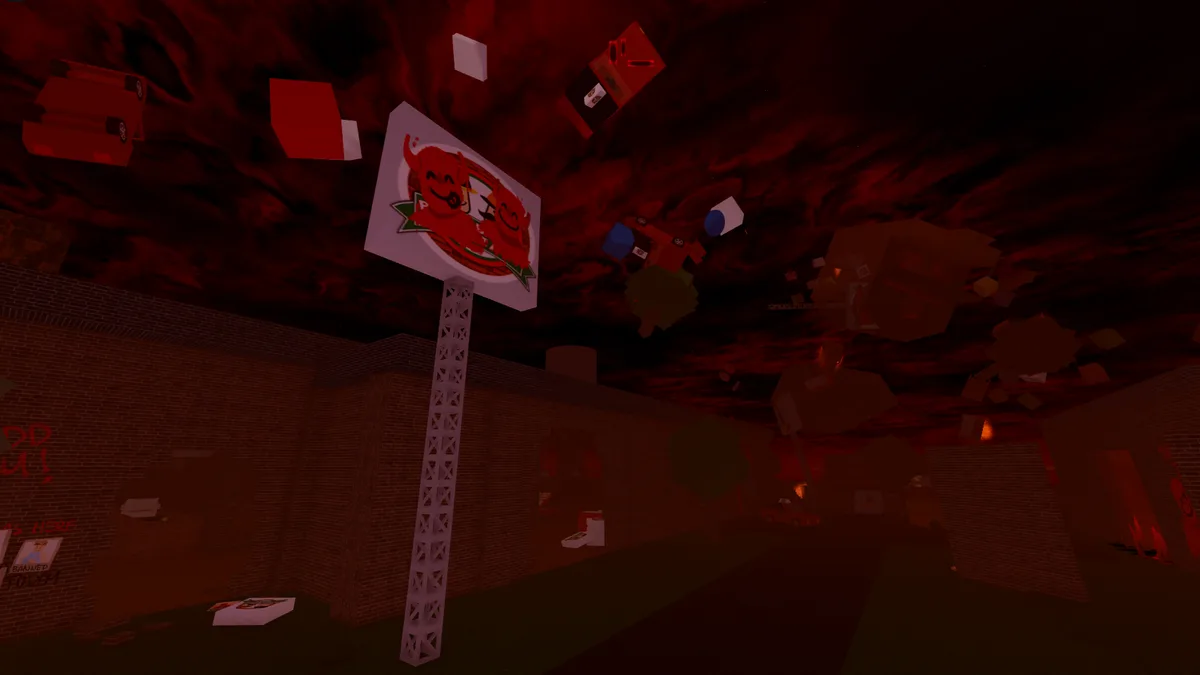
The Builder Brothers Pizza map in Forsaken. Image: Forsaken (Roblox) © Forsaken Dev Group, via the Official Forsaken Wiki (forsaken.wiki).
Final Thoughts
Work at Pizza Place captures the charm of one of Roblox's most iconic games while creating a genuinely engaging Forsaken map with strategic depth that rewards hybrid gameplay mastery. The restaurant-neighborhood duality gives this map a unique identity where indoor and outdoor skills matter equally, and the survivors who win consistently are those who flow between environments naturally rather than committing to one zone. The kitchen prep counter is your home base, the delivery vehicles are your outdoor anchor, and the neighborhood houses are your endgame safety net. Master the kitchen loop, practice the freezer door technique, and learn all four restaurant exit transitions to build the mechanical foundation. Then develop your outdoor routing between vehicles, houses, and the park to create the complete chase capability that makes Pizza Place one of the most survivor-friendly maps in Forsaken. Your improvement path is straightforward: spend 10 minutes learning the kitchen loop, 10 minutes learning outdoor routes between structures, and then 30 matches implementing the indoor-outdoor transition timing that connects these skills into seamless gameplay. Track your escape rate and watch it climb from the map average of 52% to 58%+ as your hybrid play develops. Pizza Place is not just a nostalgia trip; it is a map designed to reward versatile survivors who adapt fluidly between two distinct gameplay styles.
- • The kitchen prep counter loop is the strongest indoor structure and your primary chase destination providing 15-20 seconds of safe looping with direction changes
- • Complete all restaurant interior generators first within the opening 3 minutes to eliminate the most dangerous repair locations before killer pressure focuses indoors
- • The walk-in freezer door close technique provides 2-second guaranteed delays during chases and doubles as a stealth hiding spot when the killer loses line of sight
- • Transition between indoor restaurant and outdoor neighborhood environments every 15-20 seconds during chases to maximize total available chase time
- • Against stealth killers stay outdoors for better sightlines while against ranged and chainsaw killers stay indoors where equipment blocks their abilities
- • House generators should be saved for late game where their distributed neighborhood positions provide safe repair under maximum killer pressure
- • The restaurant has four exit points so you should never get trapped inside if you memorize all transition routes between kitchen, dining room, supply room, and office
Load a custom Pizza Place match and run the complete restaurant circuit: kitchen prep counter loop, dining table weave, front door exit, delivery vehicle loop, back alley re-entry through supply room. Practice this circuit 5 times until the transitions feel natural. This single practice routine covers the core mechanical skills for 70% of all Pizza Place gameplay scenarios.
Related Forsaken Guides
Forsaken New Player Servers 2026: How Long Until You Leave
Forsaken new player servers 2026: the playtime threshold to leave, how to queue with friends across the wall, and what changes when you graduate.
All Forsaken Characters 2026: Every Killer, Survivor & Skin Ranked
All Forsaken characters 2026: the complete killer + survivor roster with role, difficulty, links to per-character guides, and where to start for new players.
Forsaken Codes (2026): Why There Are None & How Free Rewards Really Work
Forsaken codes don't exist — the game has no redemption system. Here's why, how to spot fake code lists, and every real way to earn free rewards in 2026.
Guest 666 Forsaken Guide: Stats, Pressure Gameplan & Counters (2026)
Guest 666 Forsaken guide: community-tracked 21 speed / 220 HP stats, the pressure gameplan that wins rounds, and the survivors that actually counter him.
Roblox HQ Map Forsaken: Full Guide to the Office-Floor Hunt (2026)
Roblox HQ map Forsaken guide: how the office-floor web really plays, chain-routing for survivors, cutoff play for killers, and who over-performs here.
Back to the ForsakenHub homepage for the full Forsaken Roblox guide hub, or browse all guides. You can also play the game directly on Forsaken on Roblox.